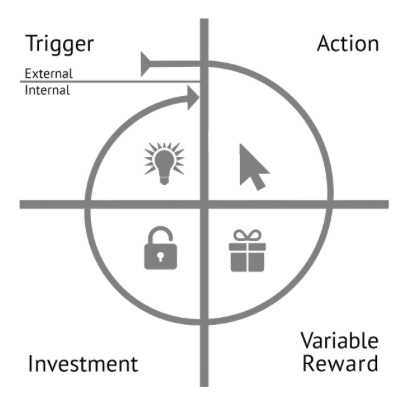
"It's easier to replace bad habits with good habits, or different habits, rather than trying to exercise your limited willpower and just not to do a thing."
There's a big difference between *passive* and *active* scrolling.
In October's Cosmopolitan UK, intrepid features editor Jennifer Savin ditched her phone for a few days, and I was invited to shared strategies with her on how to reconnect with her scroll in healthier ways.
If you too are struggling with news overwhelm at the moment, please be kind to yourself. It's a sign that you are human!Managing our attention in the digital age isn't easy but the key is gradually replacing autopilot habits with more intentional ones—which requires a much more active approach to technology.
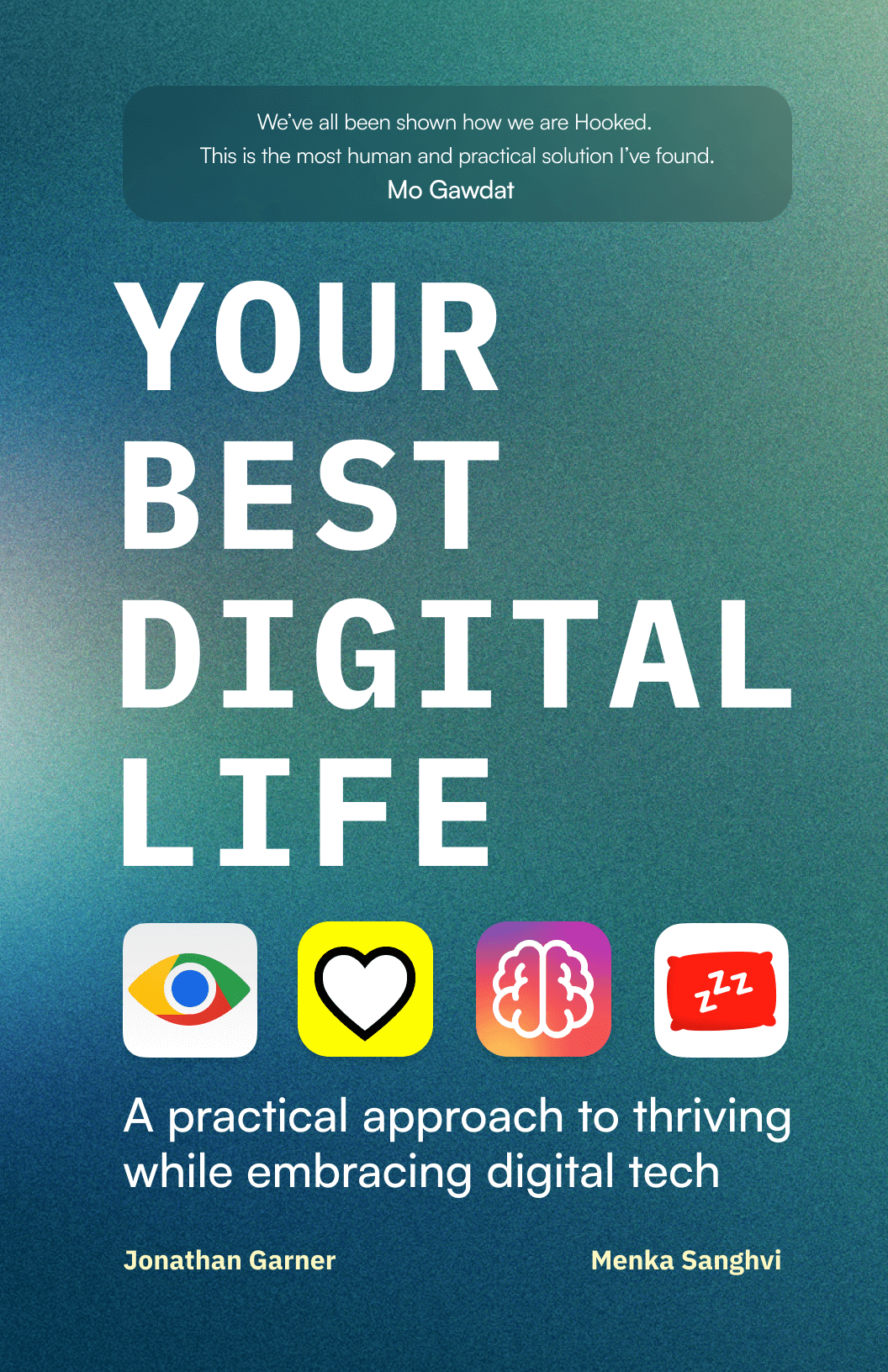
I explore these strategies in depth in my latest book with Jonathan Garner of Mind over Tech, "Your Best Digital Life" (Macmillan 2025). I'm also speaking at organisations about the science of attention and the metacognitive skills we need to thrive in an always-on world. If your team could benefit from this conversation, I'd love to connect.
We're all guilty of scrolling mindlessly on our phones, and the time lost can have far-reaching consequences. Menka Sanghvi explains the MORE method to being more mindful about your time online.
There's a particular feeling that arrives, with crushing familiarity, as you surface from a thirty-minute social media trance: the realisation that you've been scrolling without intention, without awareness, and — most distressingly — without any recollection of deciding to do so in the first place! One moment you were about to reply to an important email; the next, you're deep in a stranger's holiday photos.
Don't worry, this isn't a prelude to suggesting you throw your phone into the sea (though I'm sure the fantasy has its appeal at times). Rather, it's an invitation to consider a more aware and intentional relationship with these powerful supercomputers in our pockets—one in which our scrolling habits can have a meaningful role to play.
Understanding the scroll reflex
Before we can transform our scrolling habits, we must acknowledge what we're up against: our devices are designed to capture and retain our attention. The reflexive reach for our devices — that automatic motion toward the pocket, purse, or bedside table whenever there's a spare moment, a twinge of boredom, or a flash of discomfort — is not just us being careless with our attention, it's exactly what most apps are created to do.
Research reveals a fascinating neurological truth: our brains are flooded with far more dopamine while anticipating a reward than while experiencing the reward itself, which explains why the mere thought of checking notifications can be so compelling. Once we're in the app, algorithmically curated feeds exploit our curiosity gaps and appeal to our most ancient survival instincts to be in the know, keeping us locked in for much longer than we’d like. In other words, we zombie-scroll because we’re human!
The mindful scroll: The M.O.R.E. method
The M.O.R.E. method is a systematic approach to creating intentional digital habits through four essential steps: Mobilise, Observe, Reflect, and Experiment.
1. Mobilise – Connect with your intentions
One of the most powerful ways to move away from an unconscious habit is by creating a moment of intention. Each time you reach for your device, pause briefly and implement a simple ritual that connects you with your purpose. This could be as simple as taking three deliberate breaths before unlocking your phone, or simply asking yourself the question "Why?"
This momentary check-in isn't about judging your impulses or denying yourself access. It's simply about reinstating choice where habit has taken over. Sometimes, after this check-in, you'll still decide to scroll—and that's fine. The victory is in the awareness, not in a particular outcome.
2. Observe – Embrace curiosity
Once a day, set aside time to simply observe yourself without immediate judgment. When you find yourself mid-scroll, try shifting from unconscious consumption to curious observation.
Notice the time of day, the content that's captured your attention, and the sensations in your body. What emotions arise as you engage with different posts? Which accounts leave you energised, and which leave you depleted?
This practice transforms scrolling from a passive activity into an active investigation – an essential foundation for making changes.
3. Reflect – Analyse the patterns
Take time to process what you've observed by asking deeper questions: What patterns am I noticing? How does my scrolling align with what I value? What might my scrolling habits be telling me about my needs?
After analysing patterns with hundreds of clients, I've found that the emotional triggers for scrolling often cluster around five common states: boredom, anxiety, loneliness, mental fatigue, and decision avoidance.
Such insights convert raw observations into meaningful information that informs intentional change. You might discover that afternoon scrolling provides a needed mental break, while morning scrolling derails your productive start.
4. Experiment – Challenge yourself
Finally, run small experiments to discover what works for you:
Set time limits for apps that trigger compulsive use
Regularly audit which accounts you follow
Create designated spaces and times for different types of content
Try changing your physical environments (Do you scroll differently at a desk versus in bed?)
The key is approaching these changes as experiments rather than rigid rules for a “New You”. Remember, each provides valuable insights about your unique relationship with technology, and what helps you to feel in control again, might be useless for someone else.
From self-criticism to self-knowledge
The M.O.R.E. method offers a non-judgemental framework to help us explore our digital behaviours without amplifying negative feelings like shame or anger. Rather than pathologising screen time, this approach treats our digital life as simply another environment to navigate mindfully.
Instead of berating yourself for mindless scrolling, get curious. Your scrolling patterns can reveal your needs, fears, and desires — turning digital distractions into tools for self-knowledge.What am I truly hungry for when I reach for my phone? That Instagram account you check obsessively might reveal something about what you aspire to; the news site you can't stop refreshing might point to anxieties you haven't fully acknowledged.
This shift—from self-criticism to self-knowledge—is where the real transformation lies.
Remember it's an ongoing practice
The goal isn't to achieve some idealised state of digital nirvana. Such an aspiration only adds another layer of pressure to our already demanding lives. Instead, aim to gradually increase the proportion of intentional engagement over mindless consumption — and approach inevitable lapses with compassion.
After all, our relationship with technology isn't so different from our other relationships: it benefits from regular attention, clear boundaries, and occasional recalibrations when (inevitably) our situation changes and our needs from our devices change. That's why we call it a practice.
So the next time you find yourself emerging from a scrolling session wondering where you are, and how you got there, skip the negative self-talk and instead get into a scientific mindset. If you look closely, your mindless moments might just become your most mindful teachers.
This article was published in print and online Belfast Telegraph on 17 June 2025
The constant flood of notifications and infinite content is rewiring our brains, making it harder to focus, switch off, and truly relax writes digital habits expert Menka Sanghvi
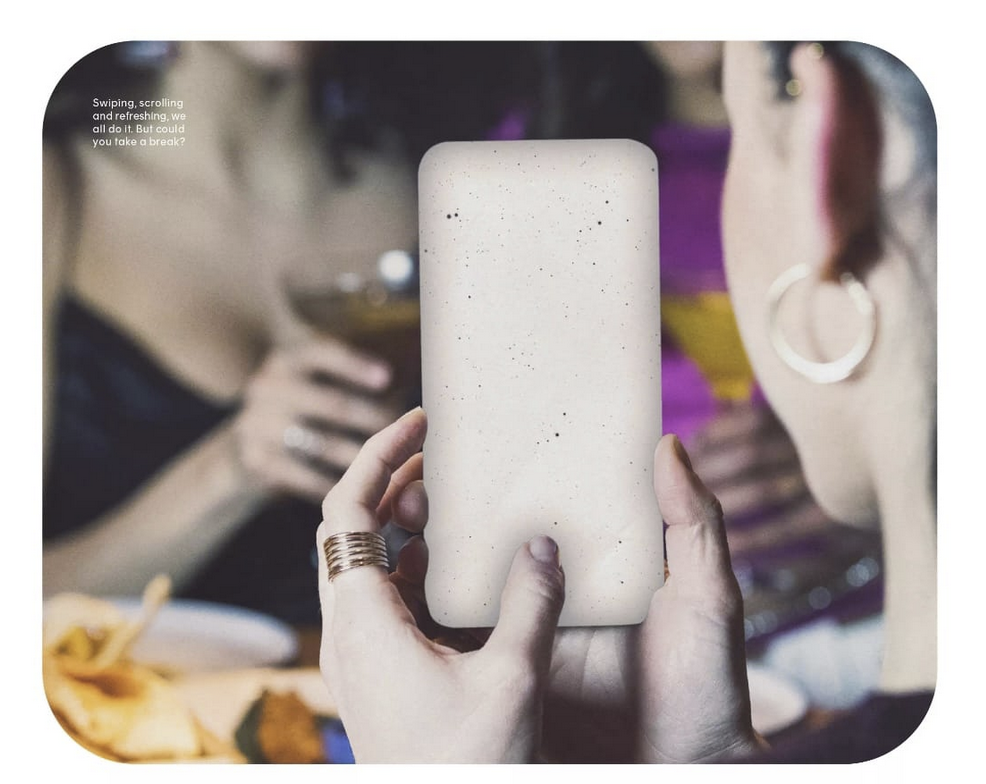
We’ve all been there — mid-conversation with a friend when our hand unconsciously reaches for our phone. Or perhaps you’ve sat down to complete an important task only to find yourself, 20 minutes later, scrolling through social media with no memory of how you got there.
Our smartphones are incredible tools that have transformed how we live, work and connect. Few of us can realistically throw our devices off Cave Hill and walk away. Instead, the key is being intentional about how and when we use our devices.
The modern distraction epidemic
The average person checks their phone hundreds of times daily — piercing their attention like a metronome every few minutes of the day. Each quick glance might seem harmless, but research by Dr Gloria Mark at UC Irvine shows it takes up to 25 minutes to return attention to a task after a digital interruption. In other words, we are perpetually distracted.
This isn’t entirely our fault. Apps and platforms are specifically designed to capture our attention through psychological triggers. The brain’s attraction to novelty and unpredictable rewards keeps us checking for new content, messages, and likes — like operating a slot machine, hoping the next swipe or scroll will be a good one.
As former Google design ethicist Tristan Harris explains, algorithms are being designed to trigger the most primitive and impulsive parts of the brain, exploiting our needs for validation, connection and instant gratification: “It’s a race to the bottom of the brain stem.”
The mental toll
This scattered attention doesn’t just affect productivity — it impacts our mental wellbeing too. Research increasingly shows connections between frequent phone checking and elevated anxiety. As I point out in my book Your Best Digital Life — Use Your Mind to Tame Your Tech co-authored with Jonathan Garner, “The cycle becomes self-reinforcing: anxiety triggers checking, checking provides temporary relief, but the overall pattern increases background anxiety.”
Our nervous systems remain in a constant state of alertness, waiting for the next ping or vibration. Even when notifications aren’t coming in, many of us experience “phantom vibrations” — thinking our phone is alerting us when it isn’t. Researchers have found that merely having your phone visible and within reach — even when you’re not using it — reduces cognitive capacity and impairs cognitive functioning.
Relationship interference
Perhaps most concerning is how our smartphone habits affect relationships. The phenomenon of “phubbing” — snubbing others in favour of our phones — has become so common we barely notice it anymore. But the message it sends is clear: whatever is on our screen is more important than the person in front of us.Even when physically present, our divided attention erodes meaningful connections. Half-listening while scrolling doesn’t create the sense of being truly seen and heard that relationships need to thrive. Indeed several studies have confirmed what we all feel: that having a phone around — again, even if you’re not using it — leads to lower levels of closeness, connection, and quality conversations.
Experimenting to find what works for you
So how do we treat our smartphones more like tools that we can pick up and put down as needed, rather than like compulsive addicts? The answer, I believe, isn’t about sheer willpower, but about being curious about your everyday behaviour, and questioning it with an open mind.
In Your Best Digital Life, Jonathan Garner and I make the case for objectively observing your habits, and regularly checking that they still align with what you value. Even the most intentional digital habits eventually drift into unconscious, autopilot behaviour.
What’s essential to understand is that your best digital life will never be a static picture. What serves one person might not serve another, plus what works for you today might not tomorrow.
This is why you need to have a reliable method for continually experimenting and adapting your use of technology as your needs and situations change. Here are some experiments you could try today:
⬤ Experiment 1: Practice Box Breathing When you’re feeling stressed or anxious, instead of turning to your closest device, take a minute to breathe intentionally. Inhale for four counts, hold for four, exhale for four, and hold for four more. This slow, deep, diaphragmatic breathing helps calm your nervous system, making it less likely that you’ll need a digital pacifier.
⬤ Experiment 2: Create Distance Charge your smartphone outside your bedroom and use a dedicated alarm clock instead. This physical boundary helps you to switch off at night, and prevents your phone from being the first and last thing you engage with every day. It can be a game-changer.
⬤ Experiment 3: Activate Grayscale Mode Nearly all our phones have a setting that turns the screen black and white, making it drastically less appealing! Without vibrant colours, apps lose much of their visual pull. It’s remarkable how this simple change reduces the urge to mindlessly scroll.
⬤ Experiment 4: Communicate Your Tech Use When you need to use your phone around others, speak out loud what you’re doing: “I’m just checking when the next bus arrives” or “I need to quickly respond to this work message.” This transparency acknowledges the other person’s presence and sets clear expectations about your attention.
⬤ Experiment 5: Apply the 10-Minute Rule When you feel the urge to check your phone, make yourself wait 10 minutes first. This creates a buffer that often breaks the immediate impulse while giving you time to reconnect with your intentions. You might find the urge passes, or you might still check your phone — but you’ll do so more consciously.
The beauty of these experiments is that they’re subtle, small changes that won’t cost you much in time or effort. But if they work for you they could have a huge potential upside in regaining agency over your attention and emotions.
Changing your digital habits isn’t a one-off endeavour. It has to be an ongoing practice. If not, the next wave of tech will throw you off again.
Remember, the goal isn’t to use your tech less, it’s to use it more intentionally. And perhaps that’s the most liberating realisation of all — this isn’t simply about making your phone less available, it’s about making yourself more available to the things that matter.
Menka Sanghvi is co-author of "Your Best Digital Life – Use Your Mind to Tame Your Tech" with Jonathan Garner
Menka Sanghvi is a mindfulness and digital habits expert based in London, and co-author of Your Best Digital Life — Use Your Mind to Tame Your Tech with Jonathan Garner. She has over 20 years of experience in behavioural change, systems thinking and well-being science, and has worked with global organizations including the United Nations. She shares her latest thinking on AI on her Substack: Trying not to be a bot
As algorithms guide our every move, the line between convenience and control gets blurrier. Unsplash+
In March 2021, a driver in Charlton, Massachusetts, plunged his car into Buffumville Lake while following GPS directions. Rescue teams were called to recover the completely submerged vehicle from 8 feet ofwater. The driver thankfully escaped with just a few minor injuries. When asked why he drove into a lake despite being able to see thewaterahead, his answer was simple: the GPS told him to go that way. We’ve all heard these stories, and let’s face it, they sound ridiculous. But here’s the thing: We are all somewhere on this spectrum of conveniently handing over decisions to our friendly bots.
The Silent Surrender of Decision-Making
As a society that prizes autonomy and independence, it’s surprising that we’ve gradually outsourced more of our decision-making to algorithms, often without even realizing it. What began with navigation has now expanded into nearly every aspect of our lives. We defer to recommendation engines for what to watch, read, eat and believe. We consult A.I. for career advice rather than developing our own criteria for meaningful work. We ask chatbots about relationship compatibility instead of honing our emotional intelligence. It’s hard to see where the machines end and our minds begin. Digital tech is now a literal extension of our minds, and we urgently need to treat it as such.
The convenience is undeniable. Why struggle with choices when an algorithm can analyze thousands of variables in milliseconds? Why develop your own expertise when you have access to a myriad of geniuses in your pocket? But this convenience comes with a subtle cost: our agency as human beings. We think of technology as supercharging what we want to do anyway, but there’s a thin line between facilitating what we want and manipulating it. The way this happens is often so subtle that we barely notice it happening, explains Karen Yeung, a scholar researching what she calls “hypernudging,” or how A.I. shapes our preferences.
Music streaming services don’t merely serve what you like; they gradually shift your musical taste toward more commercially viable artists by controlling your exposure. News aggregators don’t just deliver information; they subtly emphasize certain perspectives, slowly molding your political opinions. Media theorist Marshall Mcluhan recognized this dynamic decades ago when he shared the observation that first we shape our tools and then our tools shape us. Today’s algorithms don’t just respond to our choices; they actively and intimately shape them.
Living in Narrowing Information Landscapes
Any skilled delegator will tell you that one of the most satisfying things about outsourcing decisions is that it frees up the mind. And it’s true. If Sunday mornings are always pancakes, you don’t have to think (or negotiate!) with anyone about what’s for breakfast. The problem is, when we delegate our primary information feeds—news, search and social media—it starts narrowing down our core understanding of reality. To some extent, this is essential for our sanity, as there is simply too much information to process. But what happens to our ideas, motivations and actions when what we perceive as the world—our reality—is increasingly limited?
Multiple algorithmic effects are at play simultaneously. Despite the illusion of infinite choice, our information landscape narrows through personal filtering and cultural homogenization, leaving us with increasingly limited perspectives. In Filterworld, Kyle Chayka explains how algorithms have flattened culture by rewarding certain engagement patterns. Content creators worldwide chase similar algorithmic rewards, producing remarkably similar outputs to maximize visibility. TikTok-optimized homes, Instagram-friendly cafés and Spotify-formatted songs are all designed to perform well within algorithmic systems.
“This one’s for Algorithm Daddy!” explains actress and activist Jameela Jamil, as she posts a selfie in a revealing dress—a gamified move she feels she has to make whenever she starts noticing the algorithms suppressing her more substantive social justice content. Cultural diversity suffers similarly because content not in English is less likely to be included in A.I. training data.
Hundreds of people interviewed described this paradoxical feeling: overwhelmed by choice and a bit suffocated by algorithmic recommendations. “There are endless options on Netflix,” one executive said, “but I can’t find anything good to watch.” How can we make truly informed choices when our information diet is so tightly curated and narrowed?
Our Gradual Brain Atrophy
A famous study of London taxi drivers showed that their hippocampi—the brain regions responsible for spatial navigation—grew larger as they memorized the city’s labyrinthine streets. Thanks to neuroplasticity, our brains constantly change based on how we use them. And it works both ways: when we stop navigating using our senses, we lose the capacity to do so. For example, when we rely on A.I. for research, we don’t develop the core skills to connect ideas. When we accept A.I. summaries without checking sources, we delegate credibility evaluation and weaken our critical thinking. When we let algorithms curate our music, we atrophy our ability to develop personal taste. When we follow automated fitness recommendations rather than listening to our bodies, we diminish our intuitive understanding of our physical needs. When we let predictive text complete our thoughts, we start to forget how to express ourselves precisely.
In The Shallows, Nicholas Carr explores how our brains physically change in response to internet use, developing neural pathways that excel at rapid skimming but atrophy our capacity for sustained attention and deep reading. The philosopher-mechanic Matthew Crawford offers a compelling antidote in Shop Class as Soulcraft, arguing that working with physical objects—fixing motorcycles or building furniture—provides a form of mental engagement increasingly rare and precious in our digital economy. These are important and tangible trade-offs that fundamentally change us, and while they may seem inevitable in our digital worlds, recognizing how we’re shaped by every tool we use is the first step toward becoming more aware and intentional about technology.
Reclaiming Our Algorithmic Agency
The good news is that there are ways to regain control and maintain human agency in our digital lives. First, recognize that defaults are deliberate choices made by companies, not neutral starting points. Research consistently shows that people rarely change default settings. Did you know you can view Instagram posts chronologically rather than by algorithm-determined “relevance”? How many people utilize ChatGPT’s customization features? These options often exist for power users but remain largely unused by most. It’s not just about digging into the settings; it’s a mindset. Each time we accept a default setting, we surrender a choice. With repetition, this creates a form of learned helplessness—we begin to believe we have no control over our technological experiences.
Second, consider periodic “algorithm resets.” Log out, clear your data or use private browsing modes. While it’s convenient to stay logged in, this convenience comes at the cost of increasingly narrow personalization. When shopping, consider the privacy implications of centralizing all purchases through a single platform that builds comprehensive profiles of your behavior. Amazon Fresh, anyone? Third, regulatory frameworks that protect cognitive liberty should be supported. As A.I. is able to read thoughts and manipulate them, Professor Nita Farahany is among those making the case for a new human rights framework around the commodification of brain data. If not, Farahany believes that “our freedom of thought, access and control over our own brains, and our mental privacy will be threatened.”
The algorithmic revolution promises unprecedented benefits. But many of these threaten to come at the cost of our agency and cognitive independence. By making conscious and intentional choices about when to follow algorithmic guidance and when to do our own thing, we can stay connected to what we value most in each situation. Perhaps the most important skill we can develop these days is knowing when to trust the machine and when to trust our own eyes, instincts, and judgment. So the next time a bot tries to steer you into a metaphorical lake, please remember you’re still the driver. And you’ve got options.
Menka Sanghvi is a mindfulness and digital habits expert based in London. She is a globally acclaimed author and speaker on attention, tech and society. Her latest book is Your Best Digital Life – Use Your Mind to Tame Your Tech (Macmillan, 2025). Her Substack newsletter, Trying Not To Be A Bot, explores our evolving relationship with A.I.
Why going offline is 2025's new wellness power move – and how to make it work for you
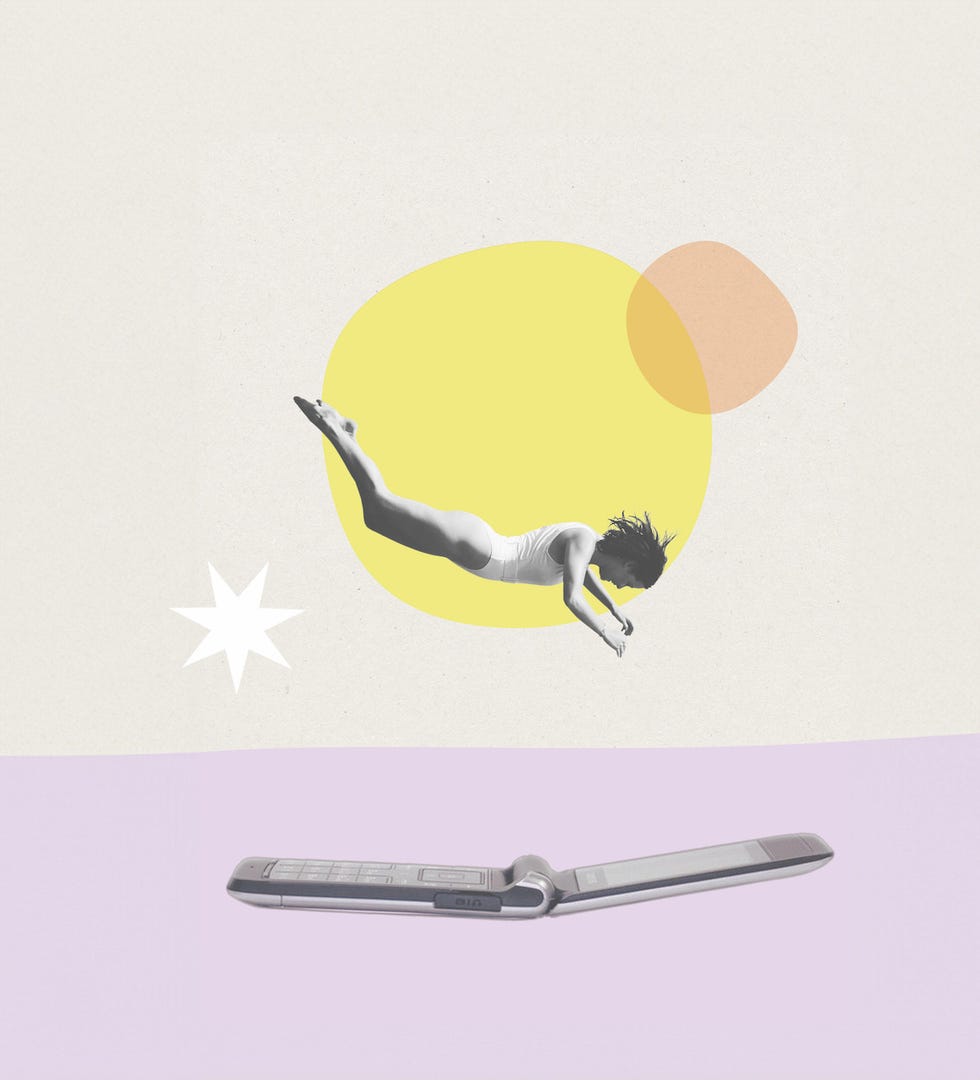
Lightning-fast wifi, on-demand entertainment and never being far from a phone charger have been the modern metrics of a life well-lived, both at work and home. So why are the best-connected women suddenly booking digital detoxes and scouring eBay for brick phones?
For Daisy Morris, the most nourishing form of self-care doesn’t take place in Pilates. Nor does it involve being tucked up in Egyptian cotton before the 10pm news. Instead, it happens on her landing. For the past four years, the 32-year-old has deposited her phone here every evening; as of January, she deleted social media from her device entirely.
Far from being a technophobe, Daisy is the founder ofsocial media consultancy The Self Hood, which services Gucci, Apple and Meta. But when a professional life built on online foundations collided with the pandemic, warping work-life boundaries, screens became her go-to.
‘By night, I was utterly exhausted but struggling to sleep; by day, I was receiving voice notes in lieu of in-person catch-ups and would be so absorbed by TikTok that I’d miss my Tube stop,’ she describes of her constant phone use. When she became so anxious that she started having heart palpitations and losing hair, her GP referred her for further tests. Only one apparent cause appeared to connect the dots: Daisy was suffering from being chronically online.
Screen timeout
If it’s been less than 60 seconds since you last looked at your phone, you’re in good company. Almost 85% of those aged 16 and over now use a smartphone in the UK – and we aren’t just making phone calls.
Data from the screen-time-tracking app Opal reveals Brits spend an average of five hours and six minutes on devices daily – a figure that goes some way towards explaining the finding of a 2023 study by the Universities of Toronto, McGill and Harvard that around a third of adults are at risk of smartphone addiction. With women under 40 identified as the most susceptible, concern about how long you’re spending logged-on has become a personal endeavour.
‘Digital wellbeing once dwindled at the bottom of to-do lists, alongside drinking more water and pelvic-floor exercises,’ says Menka Sanghvi, a digital habits expert and co author of Your Best Digital Life. ‘Then there was a turning point, half a decade ago, when The Social Dilemma documentary drew attention to the potential negative impacts of the algorithmic arts that tech companies, such as Facebook, Google and Twitter, use to keep us scrolling.’
As we wise up to those tactics, going offline is having a cultural moment. Last year’s Oxford Dictionary word of the year was ‘brain rot’: the state of mental decay from gorging on low-quality online content. At the top of bestseller lists, Nir Eyal’s Indistractable, Anna Lembke’s Dopamine Nation and Cal Newport’s Digital Minimalism are all linked by the theme of rediscovering contentment in the real world. Mikey Madison, the 26-year-old Anora actress, recently picked up an Oscar without a social media account to her name.
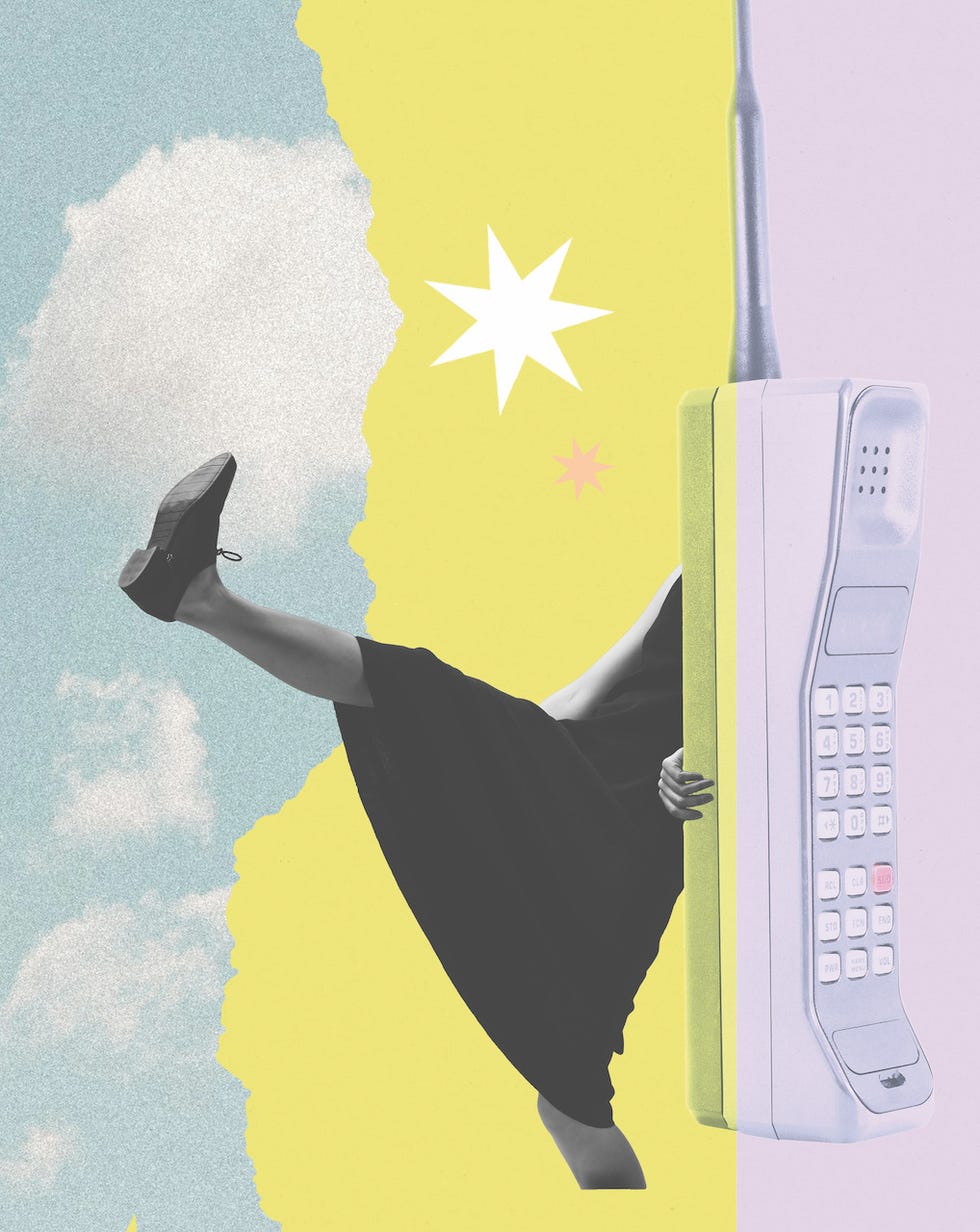
But perhaps the surest sign that we’re (re)entering our analogue era is the industry that’s sprung up around it. Take the renaissance of ‘dumbphones’. Most phone companies never stopped selling the low-tech relics lying dormant in your junk drawer. But dumbphone-specific brands are launching faster than you can say ‘snake’, with the market projected to hit a £7.78bn valuation this year. Digital detox apps are predicted to create an industry worth £14.98bn by 2032, while the past 12 months witnessed a 50% rise in searches for ‘digital detox retreat’. So, if you felt a pang of envy watching The White Lotus cast hand over their devices for a week, could going analogue be a health habit worth plugging into?
Left to your own devices
For one, there’s growing awareness of the false economy of dropping 30 quid on a sound bath, only to subject your nervous system to rage-bait headlines and work notifications in the afterglow; research published in January* found almost half of 18- to 34-year-olds now view their online activities as being more disruptive than beneficial to their wellbeing.
Talilla Henchoz is at the heart of this vibe shift. As a fitness influencer with more than 250,000 followers, Talilla considered being logged-on a prerequisite for career success. It was Johann Hari’s Stolen Focus that led the 31-year-old to link her inability to concentrate in meetings and on tasks with soaring screen time. Since she started using Opal’s app blocking features to curb time on email, Instagram and WhatsApp, she’s shaved around two hours off her daily time online.
August Lamm is leaving no such margin for error. Like most members of Gen Z, life before the 29-year-old artist was handed a smartphone at 15 is hazy. She amassed a following of 170,000 as an art influencer on Instagram, where she’d book commissions, sell prints and work on partnerships. That is, until she was locked out of her account in 2022. Realising how dependent her professional and social life had become on social media, August purchased a dumbphone. Today, she campaigns against tech being the default.
‘I was told having [a smartphone] was as normal as brushing my teeth,’ she tells WH, with a palpable anger that smartphones were sold to her generation without a second thought. ‘I’m bitter that thousands of hours were taken away from me. Shouldn’t we know what it’s like to live without them before making a decision that we want them in our lives?’
Cue the women adopting a part-time approach. Some run ‘slow inboxes’, checking emails every 48 hours. Rosie Davies-Smith, founder of a PR software company, deleted emails from her phone after ‘inbox anxiety’ was affecting her daughters, aged four and five. ‘I would be stressed and hurry their bedtime just to get back to my inbox,’ admits the 37 year-old, who now only emails during work hours. As well as being more present at bedtime, she’s putting the time she isn’t spending scrolling to good use by doing some exercise and – on rest days – journalling.
'I feel more connected to the world around me'
One early adopter, 35-year-old fair fashion campaigner Venetia La Manna, coined #Offline48 in 2018 – a hashtag to encourage logging off at the weekend – and she remains deeply committed. She either turns her device off on Friday evening, or limits herself to WhatsApp to message family or to book transport online. ‘I’m stunned how much calmer and better-rested I feel by Monday morning. I no longer get FOMO because I feel much more connected to the world around me,’ she reflects. Another unexpected win is feeling less tempted to shop.
‘By stepping away, you realise how much we’re fed targeted ads,’ she says, noting how the current no-buy movement goes hand-in-hand with a desire to switch off.
Charging point
The trouble is, devices entice you back, says Dar Meshi, a cognitive neuroscientist and associate professor at Michigan State University, US. ‘Humans have evolved to always compute the value of certain actions,’ he explains of the process regularly used to weigh up whether going to the gym is worth the faff of changing bras.
‘At our core, we’re predisposed to desire social interactions and achieve social status.’ It’s why pangs of loneliness and FOMO feel intrinsically uncomfortable, and why you value online social interactions highly. ‘As technology has developed, it’s meant we can experience this [high-reward activity] 24 hours a day and on a greater scale than ever before.’
When you repeatedly go on certain apps – a fresh hit of dopamine released as you hunt down enjoyable content – you’re effectively hardwiring yourself to be unable to ignore your phone. ‘When you first make a decision to pick up your phone to check for notifications, your brain is making a deliberative decision – which takes a lot of energy,’ Professor Meshi explains. ‘When you do something over and over, your brain offloads deliberative decision-making (to save energy), turning it into habitual decision-making.’
So, because you’ve picked up your device from the table so many times – particularly in moments of boredom when there might be the reward of a message – it becomes automatic. ‘Problematic phone use’ – which can include social media, dating sites, online news and shopping – is something Catherine Carney has seen rising in her 23 years of practising psychiatry for the NHS and at the Delamere rehab clinic in Cheshire.
‘People experiencing anxiety, low self-esteem, loneliness or substance abuse are the most vulnerable,’ she explains, citing red-flag behaviours of irritability at not having phone access, disrupted sleep, a feeling of missing out and impacted relationships.
But in much the same way that anyone who drinks alcohol could benefit from cutting down, Professor Meshi believes the same is true for screen time. ‘People [are increasingly] seeing their relationship with their smartphone as the weak spot that undermines their other efforts,’ agrees Sanghvi. ‘It’s now normal to hear someone talking about how they manage their screen time, just as they would discuss working out – it’s a sign that you’re looking after yourself.’
Social hang-ups
That those most keen to go screen-sober are Gen Z and younger millennials perhaps points to a deeper issue at play. ‘Channelling the “good old days” when life seemed simpler,’ posits Jess Farnham. Last year, the 24-year-old marketing manager – who’s had a smartphone since she was 11 – released a YouTube documentary about trialling life with a dumbphone.
Like many people her age, Jess gets the appeal of watching re-runs of Friends – no phones in sight, just six people enjoying the kind of simple, carefree friendships that her generation crave. It’s a desire reflected in 26-year-old Adele Zeynep Walton’s Logging Off Club, which hosts monthly phone-free social events across London and southern England.
Even nightclubs, such as Manchester-based Amber’s, are placing stickers over phone cameras to enable partiers to let loose without digital inhibitions. Before you scour eBay for a piece of museum-grade tech, though, Professor Meshi is one of several experts to warn WH about a blanket vilification of smartphones.
‘They’re so important for safety,’ seconds Emma Palmer- Cooper, a research psychologist and lecturer at the University of Southampton. ‘After having my daughter, during a baby first-aid course, I was told my smartphone was the most powerful thing I could have on me if she suddenly fell poorly – you can ring someone for help immediately and search what to do while waiting,’ she explains. For Jess, the reassurance of other people being able to track her live location on Google Maps became apparent during her dumbphone experiment, when she felt on edge that family and friends had no idea where she was.
The consensus on a healthy middle ground is leaning towards using your phone as a tool; one where it’s unlikely you’ll be as tempted by Vinted as your internet banking, and one that helps you spin life’s plates. ‘It’s about actively cultivating habits that enhance cognitive function,’ says Lorenzo Cecutti, who is researching the impact of smart technology for his PhD at the University of Toronto. ‘When we delegate routine tasks to smartphones, it frees up mental resources – a process called cognitive offloading. That allows our brains to concentrate on more complex processes, such as critical thinking, decision-making and creativity, needed for larger life goals.’
Put simply, if you use your device to manage calendar appointments, set reminders or track health metrics, you can spend the extra headspace focusing on your career, sticking to healthy habits and spending time with loved ones.
'Do you put your phone down after messaging or start scrolling mindlessly?'
Tapping out
Of course, it’s easier said than done. ‘Identifying problematic use is about understanding how and why you’re using your phone,’ Dr Palmer-Cooper explains. ‘Are you picking it up out of necessity or habit? If you’ve set aside time to reply to messages, do you put your phone down afterwards or do you start scrolling mindlessly?’ Paying attention to how you feel after using your phone, she adds – refreshed or drained; informed or frustrated – can also offer clues as to whether your relationship with it is helping or hindering you.
Once you’ve established a need for change, the next step is identifying your personal patterns. ‘Knowing if you have a tendency to use your phone in ways that don’t benefit you, such as spending money or losing time when scrolling, means you can start to set boundaries with a timer or “buy later” list,’ recommends Dr Palmer-Cooper. Your schedule may work in your favour in this respect.
‘External constraints may require you to put down your phone,’ says Sanghvi, of non-negotiables such as driving, cooking, your children’s bedtime or working in an office. While you can rely on willpower, it’s what Dr Palmer-Cooper calls ‘a limited cognitive resource’. Meaning? If you’ve already swerved a 5pm americano and managed not to eat tomorrow’s lunch straight out of the pan at dinner, you don’t stand a chance against your phone.
But much like establishing a fitness routine and following a healthy diet, the best approach is the one that you’ll stick to. August is often told that using a dumbphone is inconvenient. ‘But I can’t think of anything less convenient than spending hours a day doomscrolling,’ she counters. For Daisy, the biggest challenges have been staying in the loop with both trends and friends. ‘There will be times when I’ll need to be more active online for work, but I’ve developed an understanding of the mental and physical signs of overuse, so I can catch them early,’ she describes, adding that the mantra ‘intention over attention’ helps her focus on the task at hand.
The biggest reward? A new appreciation for her offline life. ‘I’ve noticed that I romanticise little things more, I feel like I’m in less of a rush and that my days are fuller,’ she enthuses. ‘I also feel way more “in my own lane” and focused on my own milestones. I used to spend a lot of time feeling like I was behind in life, but I rarely feel that now.’ In fact, she’s very much ahead on this one.
5 ways to go from addicted to analogue
1/ Work with data
Via your phone’s Screen Time setting, find out exactly how much time you spend on your device and what on, advises Dr Carney. ‘Use that information as a starting point to work out where you can improve.’
2/ Set it to greyscale
‘The lack of colour, and one tone, makes it less interesting for the brain,’ says Professor Meshi. ‘Research says we’re more likely to choose salient things; if it’s all grey, nothing grabs your attention.’ For iPhone and Android, activate greyscale in the Accessibility section of the settings.
3/ Start small
‘Any amount of time away from your phone is beneficial for helping you feel more present, such as being immersed in a conversation,’ says Sanghvi. It might be one day a month, at mealtimes or the few hours before bed. ‘The core habit to cultivate is never to use any app on autopilot,’ she adds.
4/ Turn off notifications
‘Try this for everything, except emergency contacts, during working hours to avoid getting distracted,’ recommends Dr Palmer-Cooper. ‘Carve out a specific time to respond, such as at lunchtime.’
5/ Don't give up
‘It took me several attempts over several years to completely say goodbye to my smartphone,’ shares August. ‘People quit if they don’t feel the benefits almost immediately, but your brain has to have time to adjust.’
Photography: Getty Images / Adobe Stock / Unsplash / Paul Campbell / Kiwihug / Max Fuchs / Colton Jones
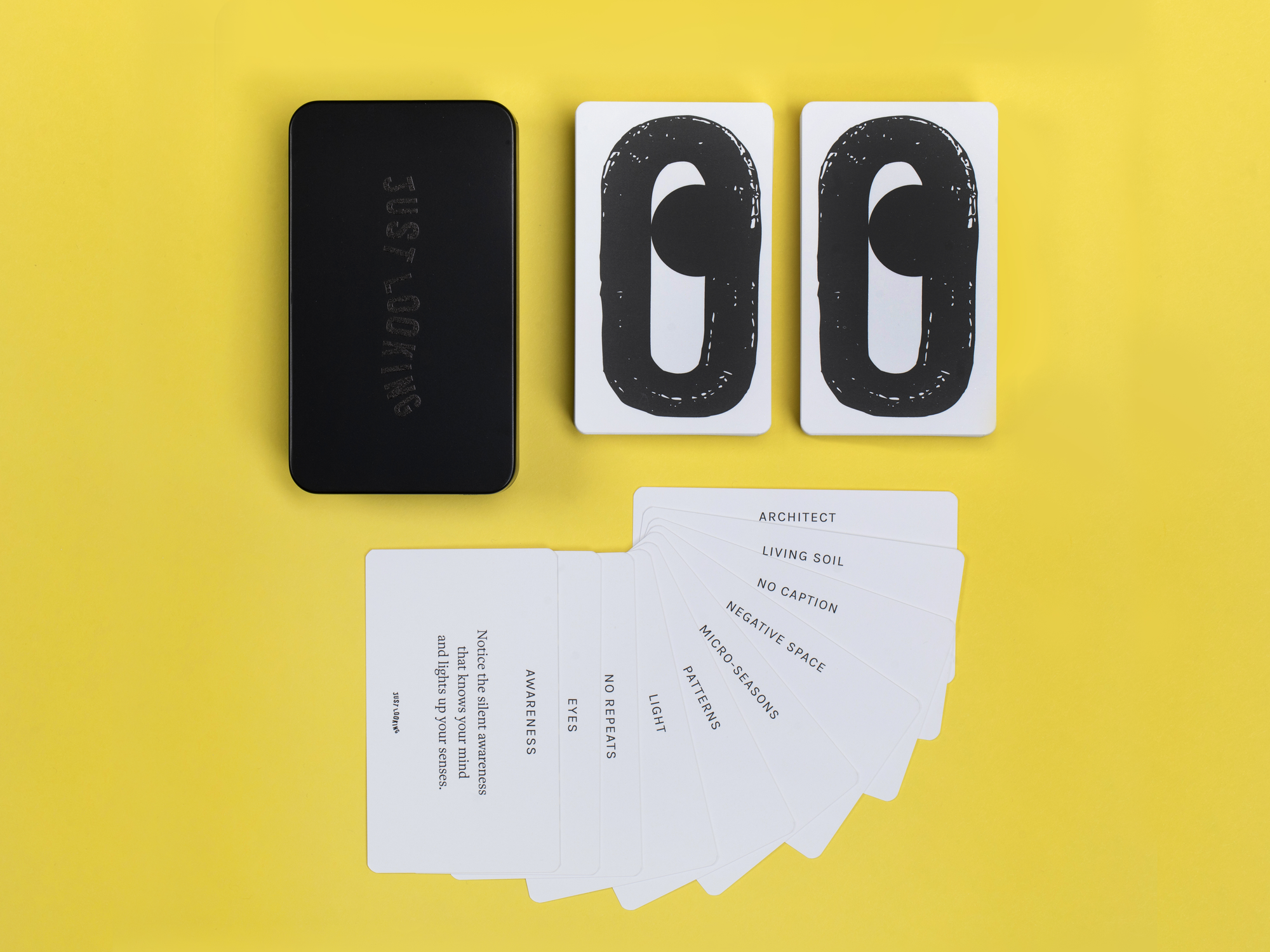
Just Looking is a community and newsletter project that celebrates slowness and curiosity. I started it back in 2017 when I found that the film of familiarity had started to dull my experience of life. The first thing I did was get people together for mindful photowalks around London, which I still love doing.
Now the community has grown globally, and we have a newsletter, books, cards and workshops too. The threads are that attention is a choice, exercising this takes practice, and there is a huge role for mutual inspiration. It turns out noticing more wonder and meaning in everyday life, like most good things, is a team sport.
My free newsletter Noticing goes out once a month – no ads, no algos, just thoughtfully curated ideas and inspiration. ☁️
Many professionals operate under a fundamental misconception: that a smartphone only impacts their focus when they are actively engaging with it. The self-aware executive who silences their device and places it face-down on the table believes they’re fully present. The disciplined manager who stows their phone in a drawer before engaging in a complex task assumes they can now focus completely.
They’re wrong.
Even when they’re switched off, smartphones compete for our attention—and the effects on productivity, wellbeing, and collaboration are far more profound than most realise.
Smartphones and the brain’s attention hierarchy
In my book I explore how our smartphones are best understood as literal extensions of our minds. These devices have become part of who we are, making it difficult to use them objectively and skilfully as tools.
What’s happening inside the brain is fascinating. Our attentional filters—neural systems that help us prioritise information—have been reshaped due to the intimate and constant use of mobile devices. Smartphones now sit at the top of our brain’s attention hierarchy, rivalling even the sound of our own names.
Out of sight is not out of mind
Research from the University of Chicago reveals that simply having a phone nearby—on a desk, in a pocket, or even powered off in a bag—reduces cognitive capacity and working memory.
The most alarming part is the lack of awareness. When asked if they were thinking about their phones during the task, participants mostly answered “not at all”, despite measurable declines in their performance.
This isn’t just theoretical, it has real implications for leadership. When your executive team brings phones into strategic planning sessions–even on silent– their mental performance suffers. Your highest-value talent is literally less intelligent in the presence of their smartphones.
The cognitive cost of constant readiness
Our brains run what’s effectively a background surveillance programme, constantly scanning for signals that the phone might need our attention. We remain ready to process notifications, mentally rehearsing possible responses, or simply aware of the device’s accessibility.
In Trying Not to Be Bot, my newsletter, I often lament how we’ve come to think of our minds like machines. While we aren’t computers, the analogy helps: your brain has limited RAM.
Even if your phone never buzzes, the mere anticipation that it might still require mental bandwidth. This invisible burden affects everything from creative problem-solving to decision-making.
Reducing the mental load
A common pushback I hear is: “Surely a quick glance can’t hurt?” But it does.
Research by Dr Gloria Mark at UC Irvine shows it takes up to 25 minutes to return attention to a task after a digital interruption. That cost compounds over time.
In digital wellbeing workshops I deliver with Mind Over Tech—a training company that builds positive digital habits and cultures— we’ve seen that physical and psychological boundaries are key. Some firms use “phone hotels” to keep devices out of meetings. Others implement “deep work” blocks—set periods where there’s no expectation to respond to emails or messages.
These approaches work not just because they reduce distraction, but because they eliminate the anticipation of distraction. When your brain knows you definitely won’t be checking your phone for the next 90 minutes, it can fully disengage from monitoring it– it stops wasting energy on background vigilance.
Beyond individual habits
Managing attention is no longer just a personal productivity tactic—it’s an organisational imperative. Leaders who understand the neuroscience of digital habits can create environments—from physical spaces to meeting structures—that safeguard their team’s most precious resource: human attention.
In today’s increasingly complex business landscape, organisations that actively protect focused thinking will outperform those merely treading water. Executives who see smartphones not just as tools, but as an integral part of their team’s attention ecosystem, will build cultures where deep focus, innovation, and strategic thinking is the norm.
The evidence is clear: your relationship with technology shapes your cognitive capabilities in fundamental ways. The question isn’t whether your smartphone is affecting your performance—it’s whether you’re ready to do something about it.
It's all about making the time we spend with our devices count. Why? Because life is short and our attention is precious.
The book is all about our relationship with digital technology, which is essentially an extension of our minds. It's not one of those digital detox books, it instead focuses on how we can make more of all the time we do spend with our tech. Not just to stay sane and out of harm's way, but to really thrive.
In 2023 we were asked to write a book about the mind and technology by Media Labs, a publisher under Macmillan USA. From the day we sat down together to plan out the book until the day the final file went to the printers, the whole process took exactly 448 days. This is relatively speedy for a full 256-page book! To pull this off the process was intense, with research, writing and editing all happening in parallel so at at any one time. It was a life of deadlines!
Thankfully Jonathan and I have worked closely together before, and we also had a fantastic editorial team whose margin comments could form a primer on diplomacy eg. "this is so interesting, but consider cutting?" when we went too far down a rabbit hole!
Perhaps what helped us the most is that we both have our daily meditation practices to ground us when things got tough. We also supported each other to take breaks from the book during the writing process. And of course, so often our best ideas would come to us right after these breaks.
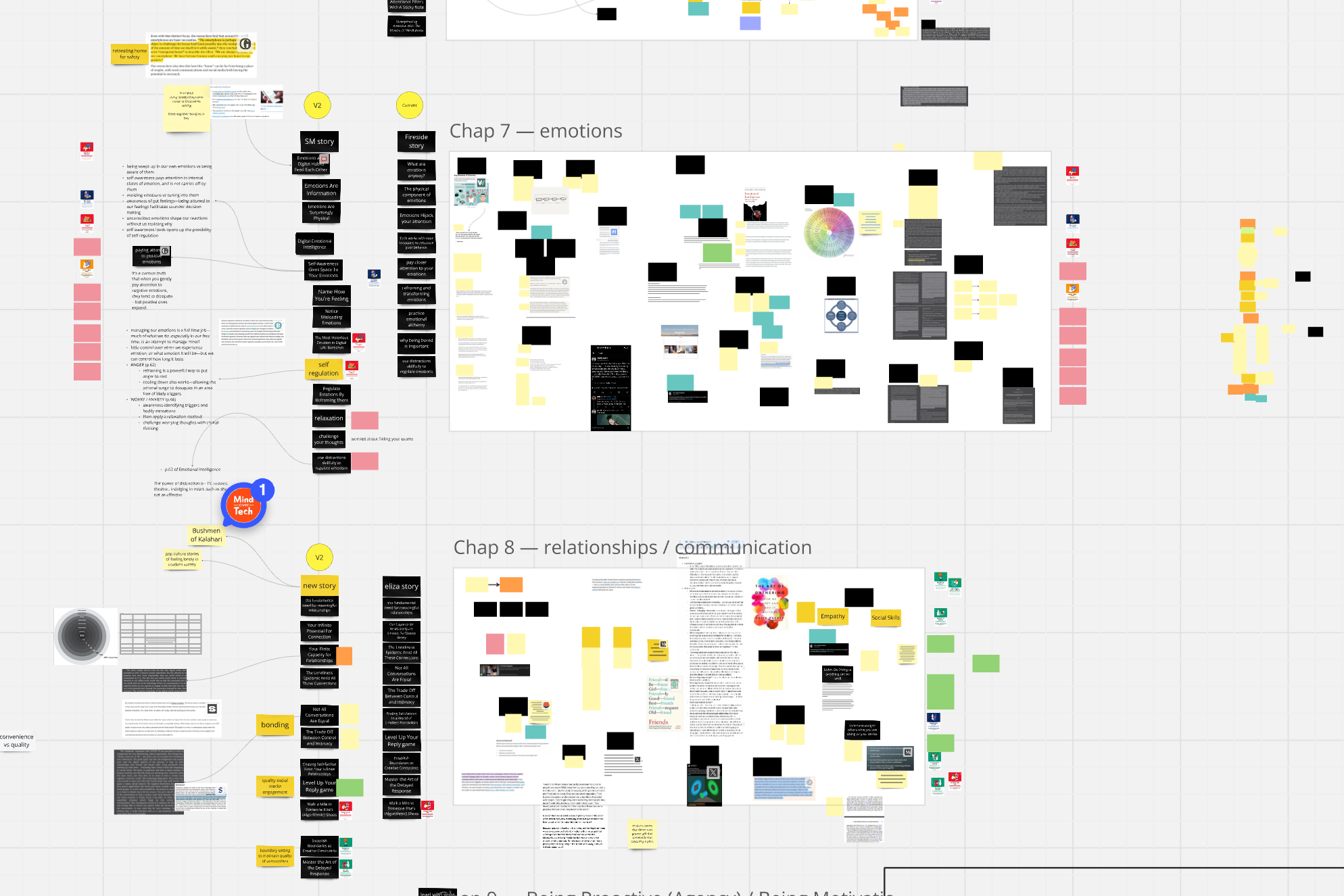
A tiny snapshot of our gigantic Miro board!
Remembering the point!
Each chapter, while in the thick of writing it, always felt like: a) THE MOST important point in the book and b) such a big subject that surely it could be a book in itself!
I am sure this is a pretty normal author experience because whatever we pay attention to expands – that's just how attention works. (Read Chapter 2 of Part 3 of our book for more on the nature of attention!) Because of this one of the biggest challenges of writing the book was repeatedly coming back to "What's the main point of this book again?" Identifying the red threads that hold it all together.
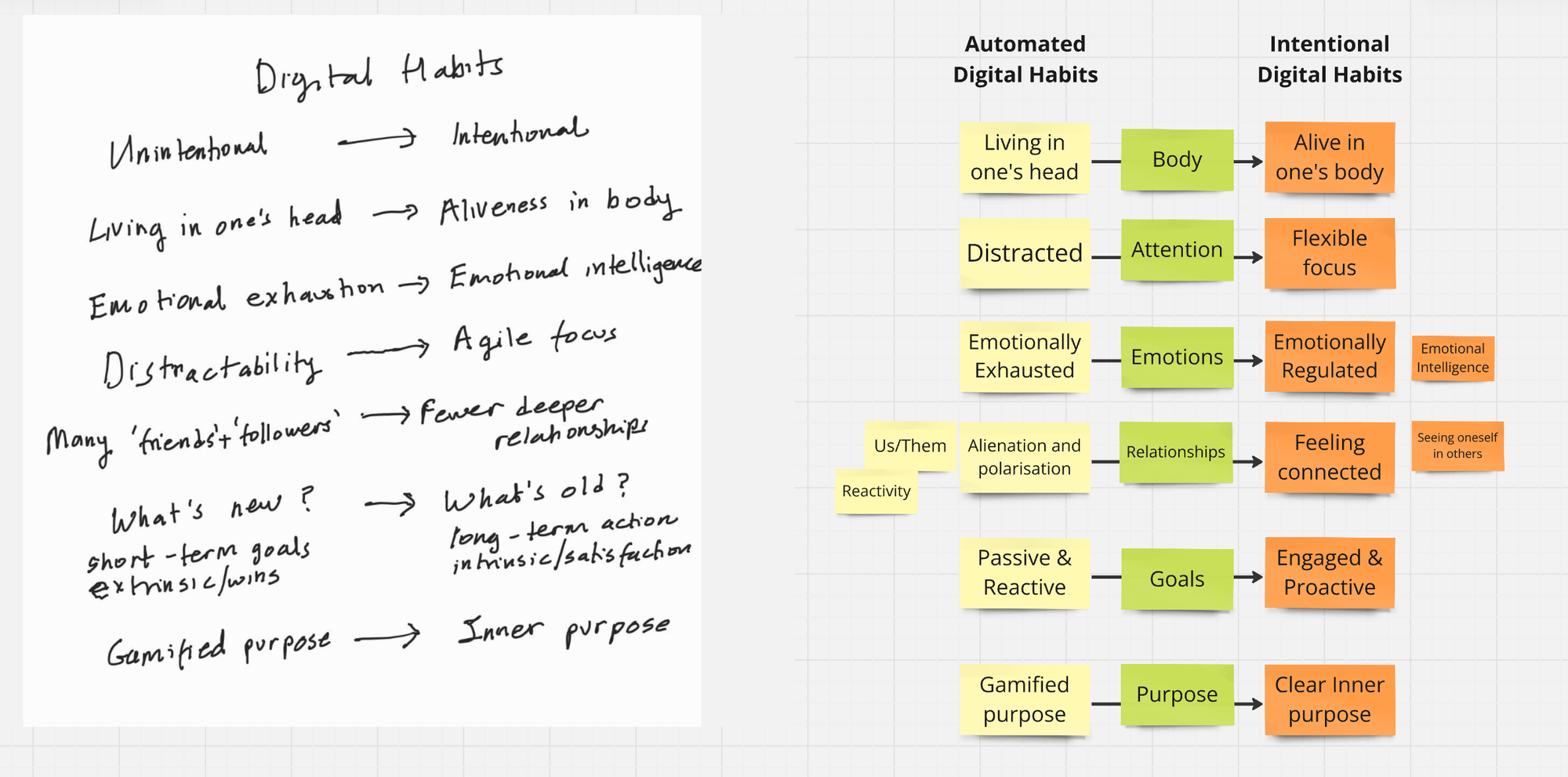
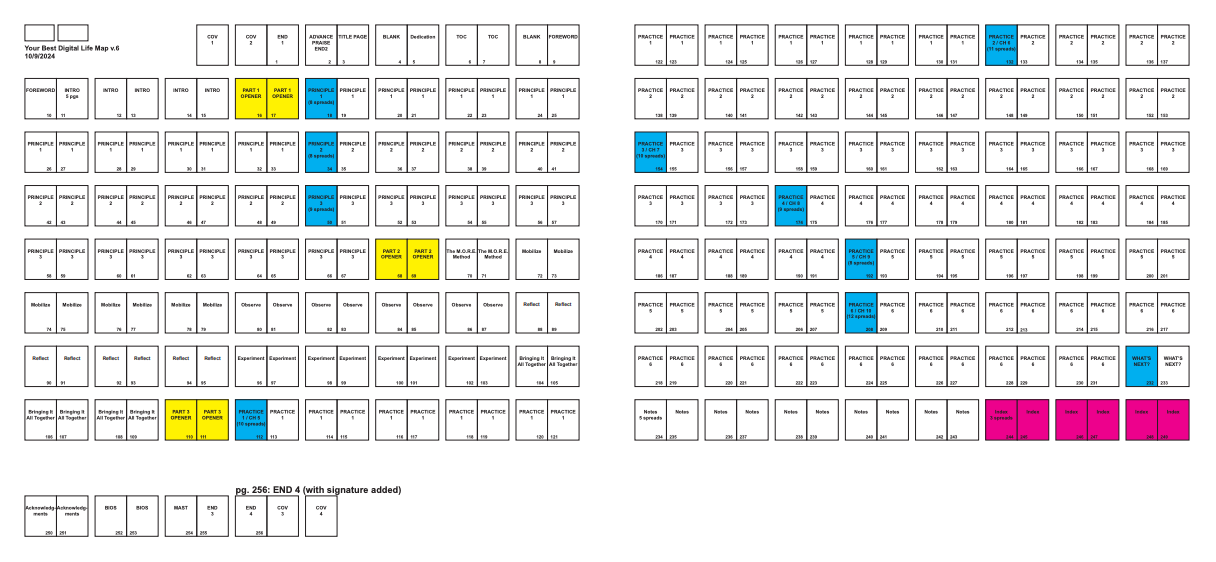
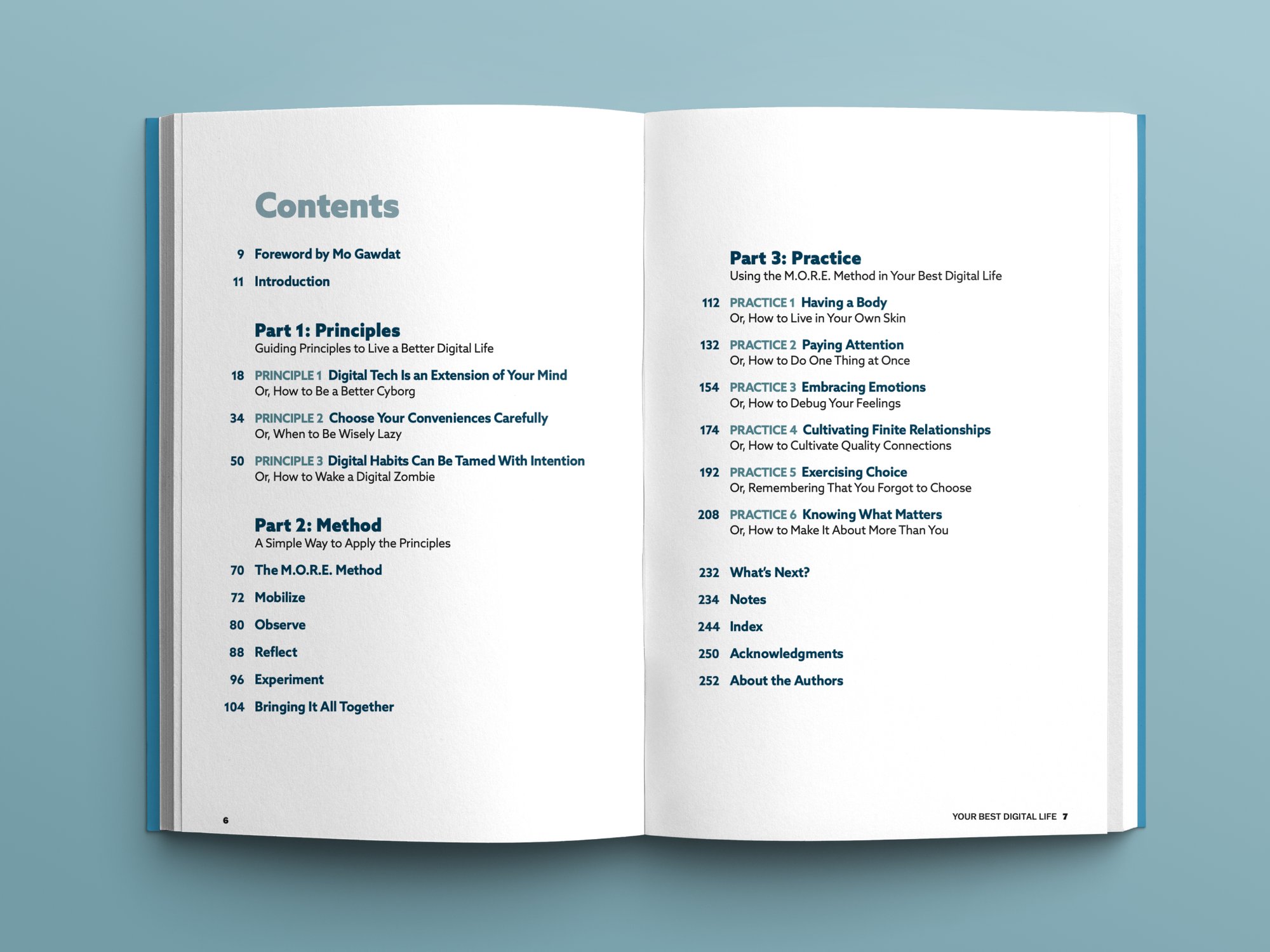
The main creative constraint, of course, was the word count and page numbers because of the physical nature of a book. We were always conscious that if we added this extra bit of research or story, we'd have to remove something elsewhere because even though we had hundreds of pages to play with, every word was a trade-off. The two images below show two different ways of thinking about the structure of the book and it was crazy hard to think about both at the same time.
Bringing it to life
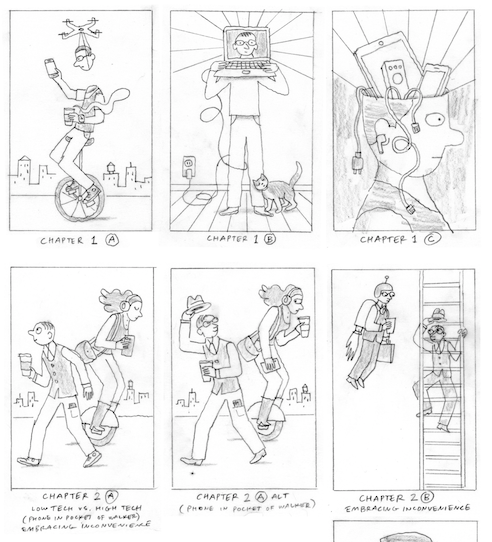
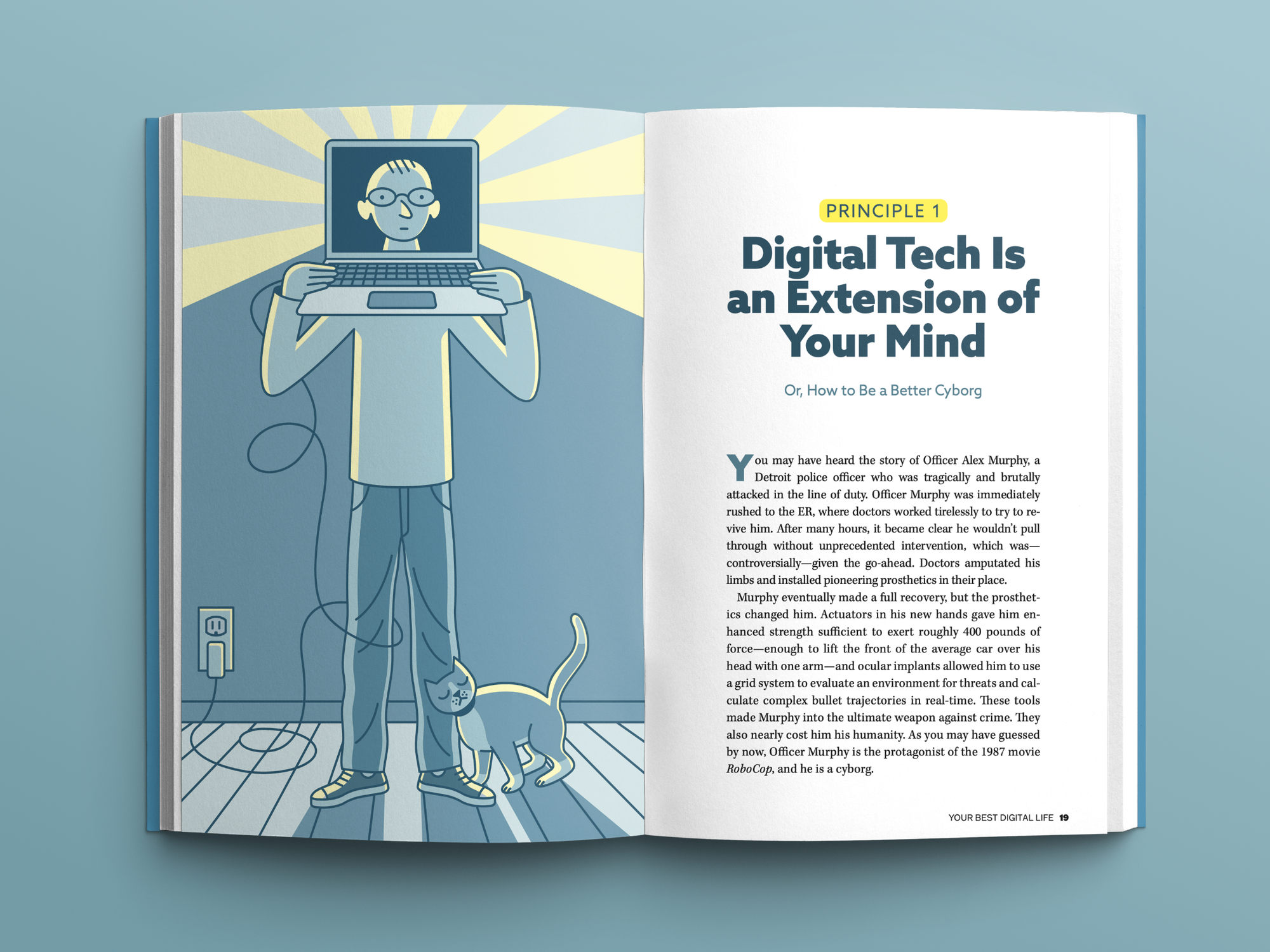
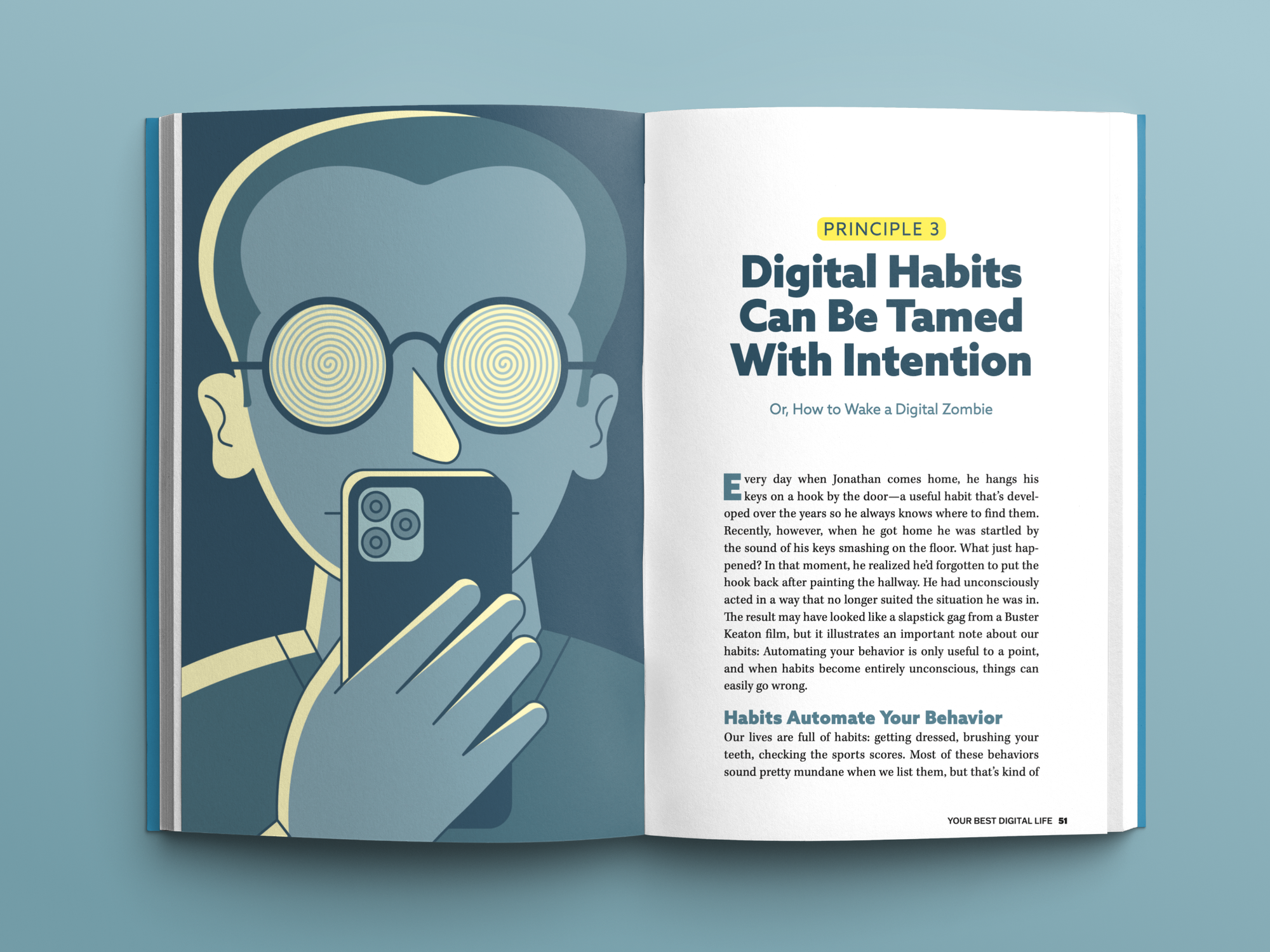
The artwork was another huge dimension for us we are both visual thinkers, and wanted the book to look the part. The publishers decided to print in full colour, and we were lucky enough to be working with an illustrator we loved: Greg Clarke who draws for the New Yorker. We sent him a summary of what each chapter was about. Not just the words, but the feeling that we wanted readers to have when they opened the chapters up.
Initial sketches for each chapter's opening illustration by Greg Clarke.
The title was suggested to us by our editors, and is a perfect example of the advantage of a third-party perspective who is close enough to understand the book, but far enough to care more about market-facing clarity than our feelings! My main objection was that this is about living your best life, not your best digital life, but I guess that's the point – for nearly all of us, our lives are "digital lives" these days, and this book is for all of us that are immersed in tech in this way.
In the end, the cover, title, subtitle and back all make a single package which has just one aim: to spark the curiosity of the kind of person who will genuinely benefit from what's inside. To get that person to open the door, and check out the contents page. Let's see how well it achieves that when the book hits the shelves. 🤞🏼
Choosing a cover
Here are some of the early iterations of the cover. It's a bit like naming a baby – after a few months none of the other shortlisted names you had once considered sound right at all! But, I still dig those app icons in Cover 2.
One Saturday morning before my four-year-old son’s swimming lesson, he grabbed my phone and insisted I leave it in the car.
“Last week I floated on my back like a starfish,” he said. “I looked at you but you were playing with your phone.”
I’d missed his proud moment, and he’d internalised that hurt for a whole week.
Let’s be clear – parents don’t need another guilt trip. I doubt I was “playing” on my smartphone. When kids are safely engaged, that’s our rare chance to get things done, often for their benefit.
I bet I was finishing a grocery order or organising a playdate. Or maybe I was watching cute animal reels on Instagram, who knows. Aren’t parents allowed breaks too?
But my son was insistent: “No phone!” So, I walked in with my pocket feeling weirdly light.
As the class started, I actually watched those small bodies moving through water. I noticed sunlight bouncing off the water, creating beautiful patterns everywhere.
How had I not seen this before?
I also felt tension in my shoulders which I hadn’t noticed all morning, until now. Not all of it was positive, but I felt more awake. My son waved repeatedly, clearly over the moon to have my eyes on him.
After marinating in digital life, ordinary things seem dull and unimportant. Shimmers of light don’t easily compete with the stunning sights and shocking news served up by algorithms.
But by removing that competition, by putting the phone away, we start to get curious about what’s right in front of us. The ordinary really can be extraordinary, when we give it our attention.
Even knowing this, physically looking up from a phone is harder than it sounds.
Smartphones captivate us biologically. Research shows our devices activate the same dopamine pathways as food and exercise.
Even when we’re not on our phone, part of our brain is engaged in thinking about it. The result? We check our phones every few minutes of the waking day, without even realising.
For parents, it’s never just about us. Every behaviour affects our kids. Studies suggest children interpret a parent’s device use as rejection. When we’re physically present but mentally elsewhere, children’s developing brains register emotional absence.
That hits home hard.
So here’s my challenge to fellow parents: experiment with leaving your phone behind occasionally. Watch your child without documenting. Embrace playground boredom. Give yourself permission not to be productive or entertained at all times.
Your brain – and your children – will experience the difference.
You may find the time you spend with your devices feels more meaningful and enjoyable, too.
The goal isn’t using our phones less, but using it more intentionally. As AI increasingly makes decisions for us, this purposeful approach to technology becomes harder and more crucial.
In my new book Your Best Digital Life, I share a concrete method for designing simple experiments that build awareness and develop new digital habits that work for you.
Every person, every situation and every moment is different. Sometimes groceries need ordering. Sometimes the most important notification is your child shouting “Look at me!” while pretending to be a starfish.
Menka Sanghvi is a leading expert in mindfulness and digital habits who speaks at organisations worldwide about creating healthier relationships with technology. Her book Your Best Digital Life: Use Your Mind to Tame Your Tech, withco-author Jonathan Garner, offers core principles and a practical method for individuals and organisations seeking to thrive in the digital age.
"Every once in a while I hit on a conversation that feels like salve for our weary souls. This week's episode with Menka Sanghvi is one of those times." - Lynn Borton
Show Notes:
“We’re not passive observers or consumers of reality. We are creators. We are co-creating this universe — and we have an impact. The way in which we see the world alters the world. It shapes us; we shape it…” ~ Menka Sanghvi
Every once in a while I hit on a conversation that feels like salve for our weary souls. This is one of those times.
Menka Sanghvi and I feel our ways around noticing as the first step to caring, taking responsibility for where and how we direct our attention, attention activism and artistry, not accepting default settings, the essence of parenting, and why looking at the sky first thing in the morning is such a good idea.
Menka is a mindfulness and digital habits expert based in London. Her writing, speaking and many projects explore the relationship between attention, technology and society. She is the founder of Just Looking — a community project that champions more curiosity and wonder in the everyday — and co-author of the newly released book Your Best Digital Life: Use Your Mind to Tame Your Tech.
I think that we have this idea that attention does its thing, and then we notice something and then we get curious about it — and I think that does happen — but I also think that curiosity has a role to play before that noticing, to open us up to be interested, to notice in the first place.
We touched on all sorts of wonderful curiosity-friendly resources in this conversation:
Sam Harris, neuroscientist, philosopher, New York Times best-selling author, source of the burning house analogy.
Sophie Howarth, author of Everyday Wonder: how to find beauty in the ordinary and source of “skies before screens”, inspired by poet Mary Oliver.
Dictionary of Obscure Sorrows, a compendium of new words for emotions, created by John Koenig, inspiration for Menka’s Just Looking card “Each random passerby is living a life as vivid and complex as your own.”
Jay Vidyarthi, self-described “attention activist”, has a Substack on mindfulness, technology and design.
Center for Humane Technology focuses on transforming the incentives that drive technology, from social media to artificial intelligence.
We often hear the advice to "just treat technology like a tool," as if our smartphones and laptops are no different from hammers or screwdrivers. But this misses a crucial point: the relationship between humans and technology is far more complex and bidirectional than we realize.
As I explore in my new book "Your Best Digital Life," we don't simply use technology in isolation. We shape our tools and thereafter they shape us—a insight popularized by John Culkin, a friend and colleague of media theorist Marshall McLuhan, when explaining McLuhan's ideas about technology's impact on society. This isn't a new phenomenon; it's been happening throughout history.
Consider the washing machine. When it was invented, everyone assumed it would reduce women's domestic labor. Instead, it actually increased their workload. Why? Because societal expectations shifted. The washing machine changed the way people think about cleanliness and hygiene by promoting a culture of cleanliness and hygiene. Suddenly, men were expected to arrive at work in perfectly clean shirts daily, rather than the weekly washing that had been acceptable before. What began as a labor-saving device gradually raised society's standards for what constituted "clean" clothing, creating new expectations and social pressures.
Here's a clip from my recent talk at the Leathersellers' Link and Learn event where I talk about this.
0:00
/0:46
The same dynamic plays out with our digital devices. We might use GPS to navigate more efficiently, but over time, this convenience can atrophy our natural sense of direction. We might turn to social media to feel connected, but prolonged use can actually make us feel more isolated.
The key insight is recognizing that every technological choice we make doesn't just affect what we do in that moment – it gradually changes who we become. When we acknowledge this two-way relationship, we can make more intentional decisions about which technologies to embrace and how to use them in ways that align with who we want to be.
The question isn't whether technology will change us. It's whether we'll be conscious participants in that transformation.
____________________________________________
For more on how tech and particularly AI is shaping society, follow Menka's Substack:
Whenever I'm asked about how to make the most of AI in an organisation, my advice is simple: lean in! The best—possibly only—way to figure out which apps and ground rules might be effective for your teams is through active curiosity and experimentation.
I had the pleasure of speaking at The Leathersellers’ Link and Learn event last week (18 March 2025), representing Mind over Tech, where we explored AI’s role in the charity sector. A huge thank you to Stacey Lamb and the team for the invitation. The room was filled with inspiring charity leaders, and I kept thinking—if technology could amplify the reach and impact of their work even slightly, the ripple effect on people’s lives would be extraordinary!
It was a privilege to be part of a thought-provoking panel discussion alongside Chris Martin (former CEO of The Mix), Magid El-Amin (Catch 22), and Sam Talbot Rice (Farrer & Co). Our conversation was a great reminder that organisations are taking a wide range of approaches to AI adoption, and ultimately, it all comes down to leadership and culture.
📹 Thanks to Mind Over Tech's co-CEO Harriet Pellereau for capturing this clip!
"My advice for happiness is to respect your mind and embrace single-tasking, focusing on one thing at a time," says Sanghvi, whose new book, Your Best Digital Life: Use your mind to tame your tech is due to be published in May 2025.
To celebrate the United Nations International Day of Happiness, seven leading experts share their top tips on how to not only be a happy entrepreneur, but also create a happy working environment for others:
One thing at a time In today's digital age many entrepreneurs will feel pressure to be connected at all times, whether that is with their teams, customers, stakeholders or just to know what is happening in the world that could impact their business. It leads many of us to worry about just how much time we are spending on our smartphones.
However, the underlying issue, according to mindfulness and digital habits expert Menka Sanghvi, is not how much time we spend on our phone but how frequently we check them. "Research reveals that the average person touches their phone every 4-6 minutes – it's like a metronome piercing our attention throughout the day! From a neuroscience perspective, multitasking is a myth, and the longer we attempt it the more our attention gets fragmented. This can lead to burnout, anxiety, poor sleep and lower self-esteem."
"My advice for happiness is to respect your mind and embrace single-tasking, focusing on one thing at a time," says Sanghvi, whose new book, Your Best Digital Life: Use your mind to tame your tech is due to be published in May 2025. "If you're replying to emails, stay in your inbox doing replies for a while (a technique called task batching.) If you're in a meeting, put your phone away to fully engage. If you're checking the football score, just enjoy doing that! It's a tough practice for anyone – but your mind will thank you for it."
Many of us are juggling everyday responsibilities, comparing ourselves to others on social media, or chasing goals that never quite bring the fulfilment we expect. But true happiness comes from within, and there are ways to cultivate it, even in challenging times.
To mark International Happiness Day (March 20), we spoke to leading experts in psychology, workplace wellbeing, and personal development to uncover their best strategies for long-term happiness. Here’s what they had to say:
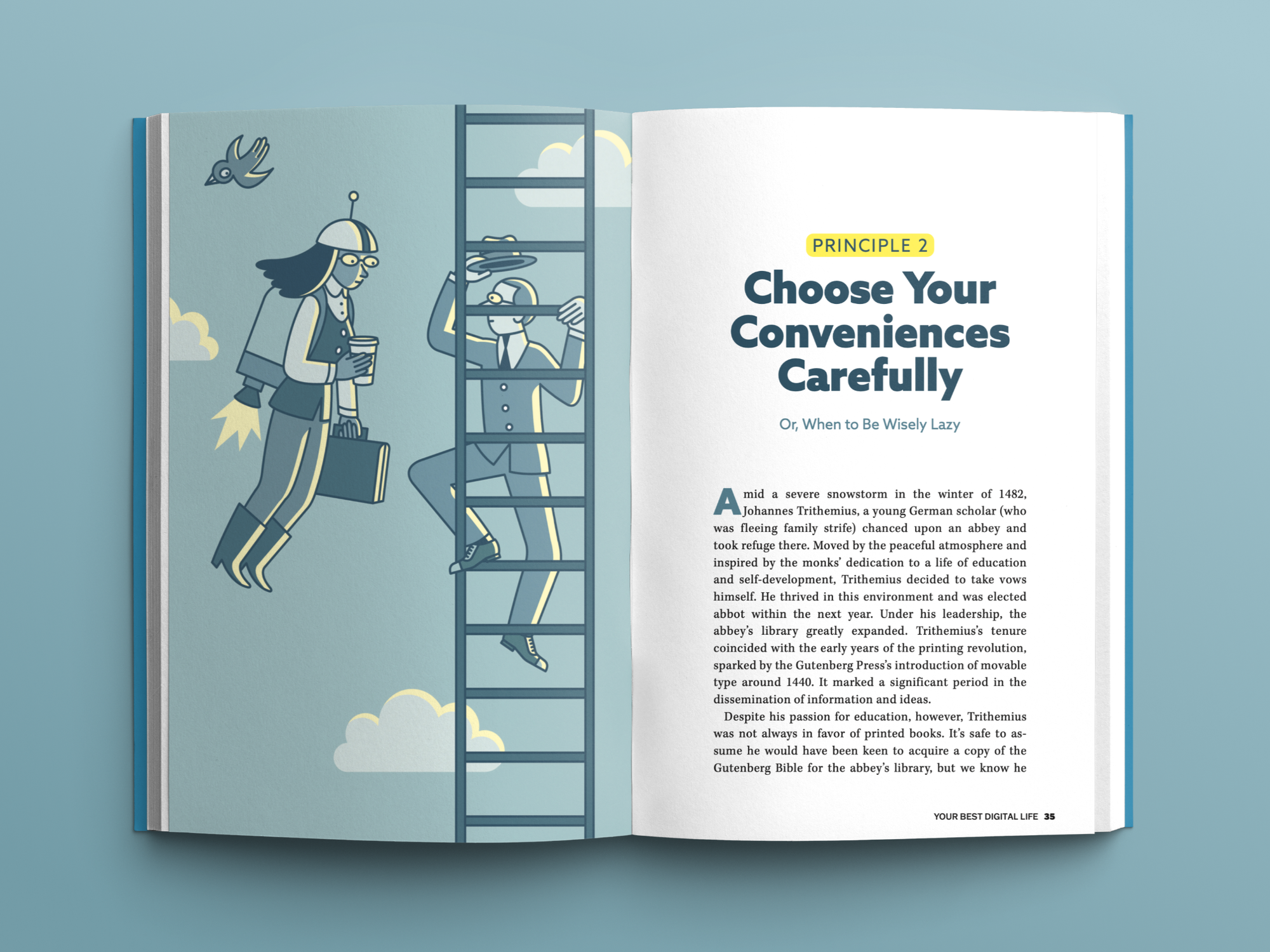
Choose your conveniences wisely
Technology is designed to make life easier, but convenience doesn’t always equate to happiness. When we rely too much on convenience, we can miss out on meaningful experiences.
Menka Sanghvi, author of Your Best Digital Life: Use Your Mind to Tame Your Tech, suggests being more mindful about the conveniences we embrace.
“Think about convenience as a spectrum and connect with your personal values to make these choices.
“By experimenting, you can figure out when it’s worth making the extra effort or tolerating some discomfort to have a more meaningful experience — whether it’s finishing that documentary you care about [rather than mindlessly scrolling] or cooking a meal at home [instead of defaulting to fast food].
“The more we practise this discernment, the more we’ll be able to pick and choose the conveniences that lead to fulfilment and happiness, and reject the ones that don’t.”
As AI becomes more human-like and empathetic, we need to treat it differently. This latest research suggests we may want to offer it mindfulness practices to help it calm down before listening to its advice. Read my post on Substack.
I came across this thought-provoking piece in The Guardian today about techno-optimism, and it got me reflecting on the power of invitation and possibility. The world needs more hopeful, optimistic narratives about the potential of technology.
If we don't create them, we risk only seeing the visions from leaders like Musk, who sees empathy as a "weakness," or Zuck, who believes feminine energy "neutering the corporate world." Add to that dystopian sci-fi like Black Mirror, and it's easy to imagine a future we definitely don't want.
Of course it is important to pay attention to these, so we can figure out how to avoid the potential harms, but we also need to inspire positive alternatives. As great parenting advice goes: "Don't just tell them what NOT to do, tell them what they SHOULD do."
Let's use our imaginations and shape the future we want to see! ✨
While going through some old boxes I found this book from 1991. The "Over 500,000 copies sold" sticker reminded me that parents worrying about kids spending too much time on screens is nothing new!
Back then, there were no on-demand shows or personalization algorithms, and TV screens were stuck in just one room! But the struggle was real. The thousands of articles and books published since on how to set healthy boundaries for children's screentime is astounding, and such a strong signal about the addictive nature of most activities served up on our screens.
I'm not really a fan of talking about 'screen time' because digital spaces are just another environment, and it all depends on exactly what we do there. The nuance is essential. But the point is, this book was popular 33 years ago, we were already aware of the issue, and yet things have only gotten harder.
Yesterday evening I went out for a walk to find something more interesting than myself. As soon as I stepped out of the door, I looked up and found it.
At our best and most fortunate we make pictures because of what stands in front of the camera, to honor what is greater and more interesting than we are. We never accomplish this perfectly, though in return we are given something perfect – a sense of inclusion. Our subject thus redefines us, and is part of the biography by which we want to be known.
Talk about the concept of "Anekantvad", the manyness of reality, given at the International Mindfulness Conference 2024 in Wales.
I had the opportunity to share some thoughts at the International Mindfulness Conference 2024 in Bangor, Wales on a panel about "Contemplative, Philosophical, and Spiritual Approaches" alongside Catherine McGee and Nana Korantema Pierce Williams.
Here is my 12-minute talk about mindfulness and the value of looking at things from many different perspectives.
Transcript:
So I'm going to share a few thoughts and ideas that are inspired by my contemplative tradition of Jainism. And I also draw a lot on a project that I've been doing for several years called Just Looking. We're going to start with this a parable story which some of you might be familiar with. It's about the seven blind men and the elephant.
And so they're all standing at different places around the elephant and the one at the, at the tail end thinks that it's a rope and the one at the front thinks it's a snake, and so on and so forth. It's not exclusive to the Jain tradition, it also appears in, in kind of Sufi stories, Hindu stories, Buddhist stories.
But in the Jain tradition, it's used to make a really specific point which is about the importance of a concept called Anekantvad. So ekant means, uh, a single sided story, and anekant means not single sided story or many-sidedness. And it's kind of been a foundation for me in terms of how I approach my mindfulness work.
You might be wondering what this is:
This is a mycelium network that connects trees. And, um, over recent years, scientists have been discovering more and more about how these networks work, fungal networks. And, um, I mean, it's amazing the level of communication. They, uh, kind of exist intergenerationally.
Some of them have been around for 2, 400 years. Uh, they've been discovered and they also nurse each other in times of difficulty. So for example, if a tree was cut down and you just see the stump left, that stump could well still be alive for 50 up to a 100 years, just because the other trees are sending them nutrients.
And why am I telling you all of this in the middle of a mindfulness conference? Because the more I talk to you about this, the more it's going to shift your perspective. So say you walk past a tree stump tomorrow, with this thought in mind, you might look at it in a different way than you would normally. You might have a softer gaze, you might have compassion, you might be inspired by it in a way that you might not have without that information, without that story that I've just told you.
So the interesting thing about what we see, or what we look at, is we would assume that most of the signals are going from the eye to the brain. But in reality, there's far more signals going from the brain to the eye, because the brain's telling kind of a story about, about what to expect, what to see. And then information is gathered from the eyes to verify bits and pieces of that and to confirm. And so when you see something like this, you see the fence, you see the hands, a microsecond later you know it's gloves.
But you keep seeing it maybe as hands again and it's hard to differentiate and it's also kind of fun when your eyes play tricks on you. And some of the best ways of exploring this is to explore optical illusions, which I'm obsessed with. I've been collecting them since university days when I was 18. And this is the oldest one I've ever found.
It's in a temple in Tamil Nadu in India. And it shows a bull, if you look at it from this side, and an elephant, if you look at it from that side. And I don't know which one you saw first or whether you could see both, but now I've told you this, you can probably see them both and switch between them.
And, and that's fun, right? It just, It just loosens our sense of certainty about what we see. So my point is that actually what we see is easily nudged.
And if you've been watching the Olympics recently I've been watching the diving and within a day or two, I was noticing the subtlety of the size of the splash. It's just because that's what I was hearing from the commentators. And, so that's what you hone in on.
We're very easily influenced by why the people around us. This photograph "The Leaning Tower of Pisa" from the 1990s embodies this. A photographer called Martin Parr, a British photographer, Magnum. And he's just got a really fun eye.
Yeah, There's no denying that our perspective is easily influenced.
On a more serious note, I spent a lot of time in my 20s working on homelessness projects, and this is a project that was in New York called, making visible. And here you see this woman walking past and not noticing these two homeless people, but it was actually a setup.
So the two, the two guys, one of them's her brother, and the other is her uncle. And she has no idea because she hasn't looked at them, looked at their faces. And then afterwards the reveal, and she's like, "Aah, I just walked past these people!".
Our attention, prioritises certain information and deprioritises other information.
And that is the conditioning that, Catherine, you were talking about. And a lot of that is societal conditioning. That's not me, but it well could be in London. I do this despite my background working with homeless people and, truly valuing them and having spent hours conversing with them.
I often walk straight past because I'm lost in, my phone. And of course, when it comes to phones, it's not just the looking down, it's what we look at inside.
So this is a sneak preview of an illustration from my upcoming book. It's called Your Best Digital Life. It's coming out next year and it is very much about what we see, what we pay attention to, because the digital world is really an extension of our mind.
The algorithms that we find in our content feeds are now starting to follow us offline too. This is a billboard in Piccadilly Circus in London. where there's cameras embedded behind the screens to recognize who's looking at the screen. And then it adjusts for age, for gender, it looks at the length of hair, and then it'll show you an appropriate ad.
And so more and more, our worlds are becoming limited. There's a kind of attentional repertoire, a cliché and a bubble that's happening because of the personalization algorithms.
This is an Instagram feed called InstaRepeat, and what he does is he looks at various influencers, what they're sharing, and then puts them together. To make the point that we often just keep seeing the same thing.
And I mean, this is pretty benign, but say you go camping, you happen to have your coffee mug and there's a beautiful background. You may well just decide to take a picture of it. You notice it more because of all the things you've seen.
How to break this up?
Lots of eyes, because that's part of the, part of the answer is to have more perspectives, more stories.
So with the Just Looking project, we have developed a series of experiments in ways of looking to encourage, the noticing of things that aren't part of our normal repertoire, that no algorithms are pointing us towards.
So This is one of them. Every second, the Earth is rotating so fast. It's at the speed of four football fields, and yet we don't really notice gravity. Something like this, where you read this and you really let it, as Catherine said, let it really sink in, or rise up in you. And then you walk around on this earth and you get a sense of being, a small being on a blue rock flying around at high speed around the sun and, that'll lead to new kinds of connections and you'll notice new things.
Here's another one which I really love.
It's inspired by the Dictionary of Obscure Sorrows. Each random passerby is living a life as vivid and complex as your own. Maybe we can we can try it for a second. Take a pause and look around and consider that the life of each person in this room is as vivid and complex as your own. You might notice a shift in how you feel about each other.
There's another interesting thing about noticing strangers is the white area around your pupil is actually much bigger in humans than it is in other primates. And scientists think that that's because it helps us to see where other people are looking. When you look at someone and their attention is on their phone or looking at an interesting thing in the sky, you follow their gaze much more easily, even from a distance.
And so we're that much more aware of other people's attention. Going back to this idea of, of what we notice is so easily influenced by others.
One more here which is very much connected to the Jain contemplative practice, this focus on impermanence. On some time scale, everything is fragile.
Tune in to this ephemerality. And again now looking around the room, maybe consider the building, consider the hill on which it stands, the mountains in the distance when you go for lunch.
It's all fragile. Again, having that story in your mind changes what you notice in the world around you. And this is not a new thing, obviously. People have been telling each other stories for eons. And this particular image is one of my heroes. Her name is Ganga Sati. She was a medieval devotional saint in India.
And here she's telling her daughter-in-law. She says "Mann ne stheer ker" Which means, "Still the mind"... "Aavo re medaan ma", which means, "And enter the playground." And what is she doing there? She's giving her a prompt. She's suggesting something pretty wild, which is beyond this body, beyond this mind. There's a whole world of things to experience, and she's drawing her attention to that based on her experience, whereas Paanbai, her daughter-in-law, has not yet experienced that.
But it opens the possibility. And this is my version of the Gangasati prompt, which I've written up, inspired by my own meditation teacher, and I often carry it around with me as a little card. Notice the silent awareness that knows your mind and lights up your senses. The beyond, the mystery and the potential wonder.
Going back to the elephant, the reminder of this elephant is that our experience of the world, what we notice is always going to be limited. So to embrace that, and that requires an epistemic humility, which doesn't come easy because we have to treat our own noticing with a certain kind of, what's the word I'm looking for?
A gentleness, and playfulness which is to know this is just part of the picture. And this concept of Anekantvad isn't actually about relativism of truth. It's not to say that, you know that, everyone's truth is subjective. This is actually about the possibility of wholeness. And that if we practice curiosity , we practice humility, we listen to other's stories, we stay open to the possibilities, we could see more, we could notice more. And that's the context that I bring this into the conversation about mindfulness is that if you were a mindfulness teacher standing there, when these people were commenting on what they see, we might well say, "good noticing!"
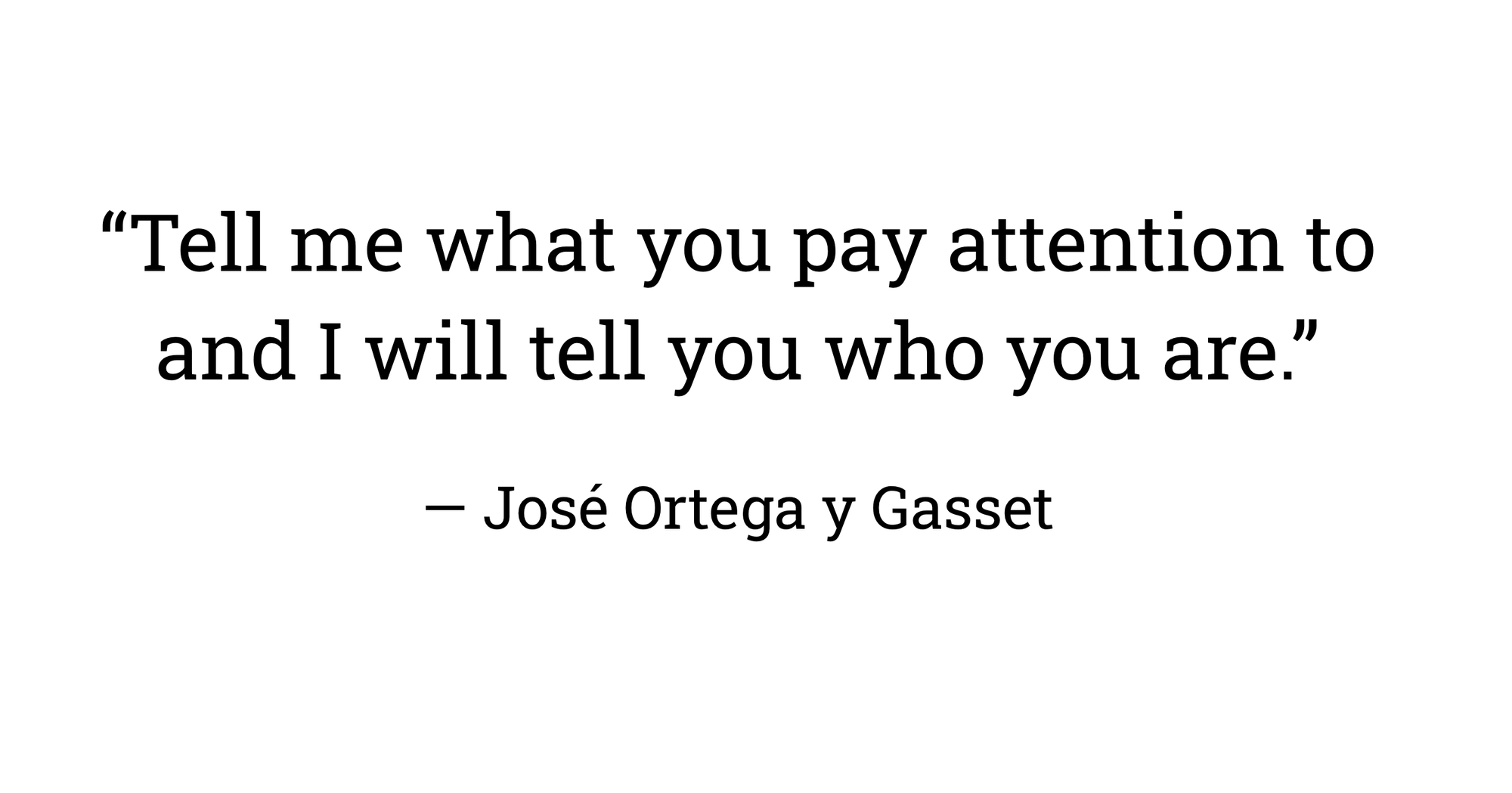
And it is good noticing, but there is more. And that's the possibility that I want to point towards. And I'll end with a quote from a Spanish philosopher, which is to do with the fact that at the end of the day, what you notice is the foundation of what you can connect with, what you care about and who you are... and what this life is for you.
And he says, tell me what you pay attention to, and I'll tell you who you are. It's a really important thing. Thank you.
There’s a lot about our digital lives that makes us feel that we’re not in control. An hour can pass by in oblivion, before we realise that we didn’t mean to be on our phones for quite so long. And as with all habits, the more we engage with our devices in this way, the harder it becomes to stop. In order to regain more personal autonomy, the authors of Mindfulness: Developing Agency In Urgent Times stress the importance of actively making conscious choices about what we pay attention to. A resounding yes! But I also worry about the number of decisions that are already made for us, long before we get to them.
Behind the scenes and screens, nearly all the information we see online is filtered for us by algorithms that carefully pre-arrange our choices for us. Almost everything we see is a “recommendation”: friends, news, adverts, movies, clothes, jobs and more. No two people see the same content because the internet is increasingly personalised based on demographics and past activity, made up of thousands of data points. Even search engines customise results based on who’s asking. Yes, we’re still in charge, but the algorithms influence us at every step.
This, in itself, is no bad thing. Given the streams of information we wade through online, it would be difficult to navigate without the help of intermediaries paring down our options. It has a healthy precedent too. Historically, we have relied upon trusted curators, advisers, and gatekeepers to make sense of the world. Thanks to machine learning, the robots assisting us today know us better than our closest confidants. Perhaps, even better than we know ourselves. It can feel good to be so well understood, to have someone by our side, finishing off our sentences.
The trouble with this cosy arrangement is that our relationship is not really with the machines, but rather with the people that create them. Filtering algorithms are imbued with a purpose, based on a business model. These are motivated not just to read our minds, but also to change our minds. The goal of social media platforms is to engage us in adverts. The goal of online shops is to have us buy more. The goal of some news portals is to change our political allegiance. These agendas – rarely stated upfront – are not objectively good or bad, but likely to be in conflict with our own.
I once tried to find out the actual criteria used by Facebook to curate my news feed, but it’s a safely guarded secret. Elsewhere, complex algorithms are simply treated as black boxes that can’t be understood entirely. However, there is a popular industry term – “relevance” – that keeps coming up in describing personalisation algorithms. As Mark Zuckerberg of Facebook explained: “A squirrel dying in front of your house may be more relevant to your interests right now than people dying in Africa.” Relevance in this context is not the same as, say, usefulness, or importance. It is simply what will engage you in the behaviour that the platform wants for you, or from you.
So what’s at stake here? Well, for one thing, we stand to lose our common reference points, and empathy for each other’s reality. In prioritising so-called relevant content, everything else slips away into the background. And the more limited our worldview, the more vulnerable we become to polarisation. Technology activist Eli Pariser coined the term “filter bubbles” to describe this phenomenon. Others call it an “‘echo chamber” in which you can only hear your own voice. These metaphors point to an underlying crisis: a disconnection from other people and their perspectives.
On these private islands, all our biases and preferences are strengthened and solidified. The algorithm observes, for example, any negativity bias that inclines us towards reading and sharing negative news. It observes the confirmation bias that draws us towards content that concurs with our existing beliefs. It notes our taste for certain kinds of movies or music. And because historical data is diligently baked into our profiles, past choices influence our present options, making it harder to make different choices now. Harder to change and grow as people. In this way, data shapes our destiny.
Mindfulness practice can help disentangle us from these forces, because it enables us step back from automatic behaviours and act with intention. Capacities such as awareness, decentering and cognitive flexibility are instrumental in avoiding the automations described. But I’m wondering: how might we need to expand and adapt our mindfulness practices to meet this new challenge more directly? Here are some ideas.
Noticing our virtual selves. We need mindfulness not just of our minds and bodies, but also of the structure of our lives in terms of our informational landscape and relationship with technology. We could go so far as to say that in addition to being physical, psychological and social beings we are also technological beings, and the online informational spaces we inhabit can be mindfully observed and inquired into as an extension of ourselves. Perhaps we need a digital equivalent of a body scan.
Studying our own biases. It has become the norm for technology companies to hire psychologists and neuroscientists into their teams, and user experience designers are trained in cognitive biases. If we want to understand how this new world of algorithms impacts us, we too need to get to know our biases better. A simple starting point is to examine the personalised content on our screens. At times the mirror won’t be totally accurate, but at other times the algorithms may have picked up on some unconscious biases that we ourselves have yet to acknowledge.
Clicking ‘out loud’. When every click, swipe and play is tracked and has a consequence, clicking becomes a lot like speaking out loud. Treating our clicks as an external expression could make us more cautious, and if we did regret engaging with specific content, for instance, a conspiracy theory video, we might make the effort to set the record straight. Some actions can be deleted or undone, such as a Google Search history or an Instagram like. We could also deliberately click on the opposite kind of content to recalibrate. Because, if we don’t clear up a misunderstanding, the algorithms won’t know that we didn’t really mean it.
Radical, mindful curiosity. When was the last time you saw something truly surprising online? When everything starts to look familiar, there is nothing more to learn. If we don’t want to be trapped in a stale information landscape we must diversify what we search for, who we follow, and what we click on. This requires an epistemic humility and mindful curiosity. Every time we actively get curious about a different culture, ideology or perspective, we retrain the algorithms, creating a positive feedback loop.
Adding friction by design. A habit is an action that has become so easy, so frictionless, that conscious intention and willpower are no longer required. If we want to change our digital habits we need to make some actions much harder for ourselves, inviting our brain’s executive control function to get involved. For example, by simply switching off the autoplay function on Youtube we create a mindful pause after one video has ended, giving us an opportunity to reconnect with our intentions.
Being more private. While we may not be able to switch off tracking and filtering entirely, there are a number of steps we can each take to increase the anonymity of our behaviours online, such that our web experience does not become as tightly personalised. For example, switching off the customisation feature in Google Search or going YouTube “incognito” will expand what we see, and diversify our possibilities.
All these responses rely on individual action, and there’s a risk here of misplacing burden. We also need to lobby collectively for structural changes including regulations for companies and government bodies that employ algorithms, asking them to provide greater transparency, accountability and controls in how their algorithms are trained, and how they make decisions about, and for, us.
If you’re still on the fence about how important this is, let me leave you with a near-future scenario to consider. Imagine wearing glasses that visually prioritise or recommend certain people as you walk down the road – reinforcing your own biases, or worse, marketing a third-party political or commercial agenda. Certain people, more “relevant” ones perhaps, might appear brighter or more vivid in this augmented reality, offering you a tailored experience of the physical world.
Anyone who has tried to meditate knows how fundamental, but difficult, it is to remain detached from thoughts, and to treat thoughts as mental events rather than facts. But when our thoughts are driven by our visual sense, it is extremely hard not to “believe our eyes”. Mindfulness may not be able to defend us from these kinds of distortions of our reality, but it will certainly give us more of a fighting chance to protect some parts of our inner lives from the influence of machines.
This essay was published in June 2021 in a collection by The Mindfulness Initiative. The whole collection can be downloaded here.
An excerpt from my Just Looking newsletter that appeared as a weekly reading for the global contemplative group Awakin.
What an honour to have an except of my newsletter appear as a weekly reading for the global contemplative group Awakin. It was narrated and translated into four languages on the website.
I once tried an improv class to see if that would finally help calm my stage nerves. It didn't. But I did learn something amazing.
If an actor is trying to show the audience that they love someone, they can do this by spending a lot of time looking at that someone. Returning their gaze to their object of love, again and again, glancing, tracking, noticing details. To us sitting in the audience, this looks a lot like love. We see where the actor's attention is going, and we intuitively sense their care. Even a child would sense it. The simplicity of this really hit home. What we look at is what we care about!
A great metaphor for noticing is "gymnastics of the attention." It comes from Simone Weil, who taught philosophy of science at the Lycée for Girls in Le Puy. She used the phrase to talk about teaching as the training of attention. And metaphors matter. This one emphasises the role of movement, practice and choice in what we attend to. Sure, we could fall (and stay up late doomscrolling), but we can also get back up and have another go. Over time, what we practice looking at is what we care about.
I began my career working on social challenges such as homelessness and climate change. Fifteen years in, I shifted my focus to the inner dimension of mindfulness, and many of my friends and colleagues were a little worried. They thought I'd been on one too many yoga retreats and given up on the hard stuff! But to me, it was the opposite. It's when we stop noticing each other, and how connected we all are that we're more likely to feel lonely, alienated, polarised and even exploitative.
So the question is: What is worth noticing? We have seemingly endless choices in our infinite scrolls and instant searches. But on closer examination, we find algorithms creating monocultures masquerading as choice. It might look like a feast, but it's mostly just corn syrup. Attentionally malnourished, we can easily start feeling disconnected from ourselves, each other and the natural world.
In my head, there is a thread of logic around slowness -> curiosity -> choice -> noticing -> connecting -> caring, but often, the words all fold into a gloopy mess of earnestness.
From time to time, when you're paying attention to something, pause to ask yourself, "Was this a choice I made?" Get curious about how much of what you see is directed by habit or external influences versus your own personal practice, your own gymnastics of attention.
Written by Menka Sanghvi. Read by Liz Helgesen
0:00
/196.392
Menka Sanghvi is an author, mother, photographer, heartivist and founder of Just Looking.
SEED QUESTIONS FOR REFLECTION: How do you relate to the notion that what we practice looking at is what we care about? can you share a personal story of a time you got really curious about how much of what you saw was directed by habit or external influences versus your own personal practice? What helps you slow down to be curious about your choices?
A unique translation of the work of the Jain poet, mystic and enlightened master Shrimad Rajchandra.
Nectar is a profound treasury of spiritual wisdom, encapsulated in letters written by the revered philosopher and spiritual guide.
These letters delve into themes of self-realization, ethical living, and the path to inner harmony, offering timeless guidance to seekers of truth. Rich in clarity and compassion, the book reflects Shrimad Rajchandra's deep understanding of human struggles and aspirations, making it a beacon for those on a journey of self-discovery.
This practical and in-depth fieldbook supports innovators of all stripes in the growing field of mindfulness training.
Innovators reading this will be encouraged to collaborate widely, design iteratively, and build reliable evidence for their offering. Drawing on expert contributions from across the sector, the book does not propose a single 'best practice' but instead shares a wealth of ideas, research, tools and case studies.
Revised and updated in 2024, the Fieldbook for Mindfulness Innovators now includes sections on social mindfulness, as well as diversity, equality and inclusion.
This resource is published by The Mindfulness Initiative, which is a not-for-profit think tank. www.mindfulnessinitiative.org.uk
Announcing the winner of the 2024 Awards at the Manchester Mindfulness Festival
Following the success of my book Fieldbook for Mindfulness Innovators, there was recognition that something more was needed – a platform to celebrate and support the emerging ideas and actors who were pushing boundaries in mindfulness practice.
In 2021, the Innovations in Mindfulness Awards were born. It was developed by myself, Jamie Bristow and Ruth Ormston at the Mindfulness Initiative, and Vin Harris from the Hart Knowe Trust as a partnership project.
It was created to address a fundamental challenge: while the evidence base for mindfulness has never been stronger, significant barriers still prevent many from accessing its benefits. As culture and technology evolve, so must the ways mindfulness is shared and practiced. Without innovation, everyday people miss out on the benefits of these inner practices.
The awards programme celebrates efforts to make mindfulness practices more accessible, diverse, and effective. The programme recognizes that mindfulness training must be developed with integrity and respect for existing evidence, while embracing new delivery methods that bring benefits to wider audiences.
It's been heartening to see how the awards have benefited winners and finalists. As one 2022 finalist, Mia Chambers, noted: "Being selected gave us more confidence that the mindfulness world saw value in what we were trying to do. It adds credibility and it certainly influences some funders." The winner of the 2022 awards, Luke Doherty, found that "Getting the award has led to developing a partnership with Mind, getting a significant amount of income to take this to the next level."
Now established as a biennial programme, the awards continue to identify and support pioneering projects that are reshaping how mindfulness reaches those who need it most.
Podcast interview talking to Karim Rushdy from Back into Being Method (May 2023)
"In this episode I’m speaking with London-based mindfulness guide, writer, researcher and photographer Menka Sanghvi.
Menka is the founder of Just Looking, a creative project to spread curiosity and wonder. She is also the producer and host of the Mind Over Tech podcast, and the author of the highly acclaimed Fieldbook for Mindfulness Innovators.
I got to know Menka because she serves alongside me as a Trustee for the Breathworks charity and she is also an advisor for several other wellbeing projects.
Her background is multidisciplinary and incredibly impressive – with a degree in Physics from Cambridge University, extensive training in design thinking with IDEO and others, and a lifelong study of contemplative practices. Previously Menka led global innovation projects for the United Nations.
Menka and I talk about her mindfulness journey, how we can start untangling ourselves from what she terms “intellectual tech” and how these technologies can either enable or undermine our wellbeing.
One final thing before we get going - The professor and researcher into attention, working memory, and mindfulness whose name neither of us could remember is Amishi Jha - perhaps a future guest on the pod.
Without further delay, here’s my conversation with Menka Sanghvi - enjoy!"
The European Association for Mindfulness led a workshop about the Fieldbook for Mindfulness Innovators, written by Menka Sanghvi.
Sanghvi’s Fieldbook has been like a Bible or to use another metaphor from the old days, it is like an almanac which gives farmers ideas of which types of crops to plant in which season, and how and when to gather. In different moments of my life in mindfulness teaching since 2019 I come back to the Fieldbook and adjust my practice and teaching ideas.
The impact of digital technology on our wellbeing. This article was originally published in Dec 2019 in the Young Jains UK magazine.
I still remember the curious status update by a friend on Facebook that intrigued me to attend a Young Jains conference years ago. That one little notification on my phone, and all the many actions that it inspired, played a large role in my eventually finding a dharma teacher, learning to meditate and deepening my understanding of spirituality.
There are many such instances when using digital technology has made me a happier, more connected, and better-informed person. We are so fortunate to have access to more wisdom and inspiration than any generation before us. It has also never been easier to be there for our family and friends, and to offer kindness to strangers all around the world.
Over the years, however, as I spend more and more of my waking hours looking at a screen, I’ve noticed that it’s not all positive. I have started to feel some negative impacts from my behaviours, particularly from how I use my mobile phone and social media. This realisation has sparked a journey of exploration and reflection for me.
Wellbeing is a product of what we pay attention to
The media is filled with worrisome stories about how technology is “hijacking the mind” and leading us to all kinds of mental health problems such as anxiety, loneliness, sleep deprivation and depression. “Have smartphones destroyed a generation?” asked the Atlantic magazine in a provocative and widely read cover story two years ago.
The crux of the problem is that our time and attention is frequently being directed in ways that do not support our wellbeing. In the UK the average person spends 24 hours every week online, and for the majority of us reading this it would be even more time than that. This time comes with an opportunity cost in terms of offline activities. And it is not just about time spent, it is also the content consumed. It is common to experience low self-esteem due to social comparisons on sites like Instagram, anxiety due to an information overload while browsing new sites, or sleep deprivation thanks to the Auto-Play feature on YouTube and Netflix.
Everything we do, feel and think leaves an imprint on the brain. The brain has a remarkable capacity to change throughout our lives which is known as neuroplasticity. The problem is that the brain doesn’t differentiate between good or bad – every action influences our neural wiring.
There was a study done back in 1995 in which adults with no experience playing a piano were taught how to play a melody which they practiced for two hours daily for the next five days. One half of the group was asked to physically play the melody, whereas the other was asked to simply sit and imagine playing the notes without touching a keyboard. Within just these few days scans showed that the brains of all the individuals had altered to accommodate their new musical skills. What was even more surprising is that both groups had the same level of change in their brain, even those that just imagined playing the piano. Neurologically, we are what we think, and so we must be careful about what we pay attention to.
None of us are immune from sticky habits
Some argue that technology itself is harmless, as it’s all about exercising choices. This is known as an instrumentalist philosophy, which I too subscribe too in general. We can choose to increase or reduce the time and attention we give to anything, such that our relationship with it remains healthy and beneficial. We can always, for example, choose to put the phone down, or take a digital detox when we need it. We are empowered by our self-awareness and self-discipline.
The problem with this alluring argument is that it makes behavioural change sound easier than it is. From a neuroscience perspective, we now know that the human brain is prone to developing habits. Most of the time, most of us are not even aware of what we’re doing, going through large parts of our day mindlessly on a default auto-pilot mode. By performing and repeating any thought process or action, new neural pathways are created in the brain, and once habits are embedded neurologically, they are hard to break.
A leading behavioural science company that helps build apps has the strapline “The brain is programmable. You just need to know the code.” App designers such as these use habit-formation strategies to get us hooked to their products as quickly as possible. One way this is done is by creating triggers (such as a notification) that will encourage us to take small actions (such as clicking or swiping) that lead to a variable reward (new messages, likes or comments) and an emotional investment in that product. This then creates a desire which is an internal trigger, unprompted by any anyone else, to continue repeating that same action.
Once our brains are trained to do something new, there is an inner momentum to keep using the new neural pathways. This makes it hard to stop certain behaviours, even if we realise it isn’t making us happy and want to stop. Nobody is immune from forming these sticky habits – even the prime minister of Norway was caught playing Pokémon Go in parliament a few years ago! It is this addictive quality that is at the root of many of the mental health problems observed.
As tech gets smarter by using machine learning and AI to identify our personal triggers and programme our habits ever more efficiently, perhaps the biggest thing at stake is our freedom to make choices and live life intentionally.
Taking back control and setting intentions
To take back control of any relationship, an essential starting point is to develop awareness about the nature of the relationship. For example, how long after waking up do we check our phones? How anxious do we feel when we are offline for a few hours? What are the external triggers (for example a notification appearing on our screen, or sitting on a train) or internal triggers (for example, a particular emotion or thought like “I am bored”) that prompt us to reach for the phone or to open a certain app? Identifying these triggers gives us the space to make better – more intentional – choices about how to respond.
A friend of mine noticed that he had a habit of frequently asking questions that popped up in his head in Google search, and then clicking from site to site, often not remembering what his original purpose to get online was. To break this habit he decided to keep a physical notebook with him and write down every search question he had in there, and then do all the searches online together later in the day. When he sat down to do these searches he would often laugh at how unimportant many of his questions seemed in retrospect. Many searches were abandoned and a lot of time was saved!
Intention is a beautiful characteristic of the human mind. As we have evolved, we have learnt to override instinctual, habitual actions using higher-level executive functions in the brain. We are able to plan, problem solve and make complex decisions. We are able to set our own goals and pursue what we believe is meaningful to us in our lives. But like any muscle, if we stop exercising our ability to override habits and act intentionally, we will lose our ability to do it.
Nir Eyal, author of Hooked: how to make habit-forming products, advocates the need for more “traction” which he describes as the opposite of distraction. These are the actions that draw us towards what we want in life. There are even apps like SelfControl and Freedom that can help by blocking the internet or certain websites for us for predetermined periods of time. This is useful but I believe that to make stronger progress we can’t just rely on technology to beat technology. What is needed is the internal willpower to master the triggers that distract us, and practices like meditation are designed to develop this capacity.
The question I’d like to leave you with is: “Does your use of technology interfere with your ability to identify and pursue the goals that make your life meaningful?” As spiritual seekers, we may have certain daily rituals, practices and readings that we wish to dedicate time to, or we may want to be in service to our families, communities and those in need – and digital technology can help or hinder us with all of these pursuits. We need to be clear about our intentions and align our actions to them. After all, as the poet Annie Dillard observed, “How we spend our days is, of course, how we spend our lives.”
Resources
Hooked: How to build habit-forming products. By Nir Eyal
The Shallows: How the internet is changing the way we think, read and remember. By Nicholas Carr
This article was originally published in Dec 2019 in the Technology edition of the Young Jains UK quarterly magazine. Many of the references for this article come from Menka’s work with Mind Over Tech.
I'm excited to share why I'm backing Stix Mindfulness– a truly groundbreaking solution addressing the children's mental health crisis. With 1 in 5 children facing diagnosable mental health issues, Stix offers something revolutionary: screen-free, interactive mindfulness technology designed specifically for ages 5-12.
What makes Stix innovative? Their dual-remote system guides children through therapeutic activities using lights, vibrations, and audio feedback – making mindfulness engaging and accessible. Developed with psychologists from Brunel University, activities include breathing exercises, balance training, and guided visualizations that teach lifelong emotional regulation skills.
The award-winning solution (2023 Junior Design Awards Gold Winner) addresses a massive market need: families on 6+ month CAMHS waiting lists seeking alternatives to medication. Early user feedback is compelling – parents report reduced anxiety and improved focus in their children.
Co-founded by the father-son team John and Liam Murphy, Stix combines human-centered design with evidence-based psychology. Their mission to "make mindfulness accessible for children everywhere" resonates deeply in our screen-saturated world.
This isn't just a wellness product – it's preventive mental healthcare that could transform how we support children's emotional development. I see huge potential in its scalability and impact.
Host and speaker at the launch of Sophie Howarth’s The Mindful Photographer held at The Photographers’ Gallery, London. (April 2022)
It was an absolute joy to be asked to host the launch of Sophie Howarth's book about mindful photography. Highly recommend it to anyone – even if you're not (yet) into photography!
A research paper examining what can and perhaps should be adapted when delivering a mindfulness-based training.
BAM! an innovative programme teaching mindfulness through boxing.
This research paper lays groundwork for adapting a mindfulness-based program. It was co-authored with Eric Loucks, Rebecca Crane, Jesus Montero-Marin, Jeffrey Proulx, Judson Brewer and Willem Kuyken. It was a follow-up to a paper that has become known as the "Warp and Weft" which is a knitting metaphor for what should not be changed (the warp) and what can and perhaps should be adapted (the weft). This paper delves into the weft.
Click on this image to download the PDF for the full research article.
Below are five recommendations from me that were published in the Dense Discovery. Issue 173, 31 Jan 2022.
A question worth asking:
‘What does this narrative do to my being?’ Every story moves us to think, feel and act differently in the world, so why not be more discerning about which ones we immerse in. Especially online, where algorithms are constantly making automated narrative decisions for us.
A video worth watching:
OVERVIEW is a short documentary about the profound experience many astronauts have on seeing the Earth from the ‘outside’ for the first time, as an interconnected, living system. It had me revisit the clichéd Blue Marble photo with fresh eyes and new wonder.
A newsletter worth subscribing to:
The Convivial Society offers clarity and insights into ‘digital wellbeing’ (although, perhaps wisely, writer L.M. Sacasas never uses that phrase). He brings a historical, moral, and philosophical lens to bear on the technologies we use today, raising questions about what we really value. Here’s a good example about meaningful silences on social media.
A piece of advice worth passing on:
My meditation teacher, in the Jain wisdom tradition, often recommends learning to forgive quickly. Holding onto anger, he says, is like holding onto a hot coal with the intent of throwing it at someone, but of course burning ourselves all the while. Forgiveness is letting go.
A Twitter account worth following:
Try Miranda Keeling for Haiku-like descriptions of everyday mundane moments. Her posts remind me how easily the humble act of noticing connects us more deeply to life. She lives in London, with a toddler, just like me, so I find her observations endearingly familiar, but the gestures are universal.
Contribution to the launch of the inaugural Imagination Zine (Oct 2021)
This could be one of the oldest optical illusions (Image credit: KARTY JazZ Wikimedia). It is a 12th-century sculpture in the Airavatesvara Temple in Tamil Nadu, India. Do you see an elephant on the right or a bull on the left?
Imagination is the interrupter of automatic predictions. – Menka Sanghvi
Imagination has a reputation for taking us away from reality. I believe the opposite is true. Whenever we look at something, our brain constructs complex jigsaw puzzles out of what we see and predicts what the missing pieces should look like. It’s only if any of those pieces turn out to be something different, that the brain is alerted. The trouble is that these discrepancies are not always picked up.
As a student of physics at Cambridge University some 20 years ago, I became quite obsessed with visual illusions. I found them humbling. On the one hand, scientists are trained to rely on their senses, to observe the ways things are directly, rather than to imagine them. But when we encounter a visual illusion, we must reckon with the impossibility of seeing clearly, let alone “objectively”. The brain fills in gaps using its imagination, and this can be so convincing that it can easily override reality.
In his book Helgoland, the physicist Carlo Rovelli writes, “Many, if not most, of the signals do not travel from the eyes to the brain; they go the other way, from the brain to the eyes… When we look around ourselves, we are not truly “observing”: we are instead dreaming of an image of the world based on what we know .” Relying on our eyes alone does not make us more grounded, but more fallible.
This is why an active imagination has become so precious to me. It is the interrupter of automatic predictions. Creating space for possibilities in the mind’s eye enables me to see more with my physical eyes. Having accepted that my experience of the world is largely based on my brain’s guesswork, I want this guesswork to be as rich as possible, inclusive of things hidden, fantastical and unpredictable. Imagination, it turns out, grounds me in reality by helping me to see more clearly.
This article was originally published in the inaugural edition of the Imagination Zine (editor: Mark Riva) in September 2021